Wednesday, December 1, 2021

Michael Sikkema : An interview with William Lessard

Small Press Intravues:
Occasional Interviews with writers working and publishing in the small press ecosystem

Interview #11: William Lessard has writing that has appeared or is forthcoming in American Poetry Review, Best American Experimental Writing, FENCE, and the Southwest Review. He is Poetry & Hybrids editor at Heavy Feather Review. His chapbook, instruments for distributed empathy monetization, will be published in April, 2022 by KERNPUNKT Press.

MK: Hey Bill, while you have plenty of poems-on-the-page, your work is often heavily hybrid, making use of hyperlinks, diagrams, received forms from very non-poetry genres. Can you tell us about that? What draws you to this approach? What about it do you find rewarding?

WL: Several things. First, it’s just a hell of a lot of fun. And surprising, because most poets still write like 19th-century gentleman farmers. Second, this material is the source code of the age we’re living in. Surveillance Capitalism, the Post-Human Era or whatever you want to call it--the point is human beings as we thought of them no longer exist. We are all augmented in some way by the algorithm, from autocomplete on our phones to the “suggested” content of our Netflix queues. My work is an attempt to represent this change, starting with the Google Patents, charts and other “non-poetic” material where it began. 

MK: There’s a common idea that writing lags behind other genres in terms of innovation. Your comment on the gentleman farmer aesthetic makes me think you might agree? I’ve also heard it said that exciting formal innovation is happening in writing all the time and it’s mostly ignored and not given a wider audience. What do you say? Do you think this is an innovation or a curation issue? Can you point us towards places that are accepting of the kind of work you do?

WL: Innovation is always happening. What changes is its visibility. These days, we are living through a period of thoughtful craft and academic professionalism. The new and the weird are out there, you just have to look for it. Social Text, Sink Review, Tagvverk, NOMATERIALISM, and Heavy Feather Review, where I edit, are a handful of magazines that dwell in the 21st century and support writers who are non-academics and outsiders and art-making weirdos like you and I. I realize I crab about this issue a lot, but the fact that we are having this conversation gives me hope. 

MK: Thoughtful craft and academic professionalism can feel like shoes that are two sizes too small, worn at the beach, while trying to do your taxes in the waves. How are you finding more dynamic and left field type stuff to enjoy? I appreciate the mags you list above. Are there other spots for us to follow? Also where are you finding inspiration? I find myself turning to comics, horror and sci fi movies, specialized nature nerd documentaries, and old school PSAs and the like. How about you?

WL: I get my tips (and a lot of my inspiration) from folks like you. Fellow outsiders. You point me to writers and presses I wouldn’t know about otherwise. 11.11 Press is one. Calamari Press is another. Action Books, Ugly Duckling Presse, Surveyor Books, and Wave are also reliable sources of interesting work. They give me a starting point or something to push against. But for a rethink of what I’m doing or a solution to a creative problem, I most often turn to Eva Hesse and Nancy Spero. They are two artists that are able to turn the most unpoetic material into the highest art. Hesse, in particular, knocks me out with the way she can find Expressionism in a tangle of wires. It’s the same informed rawness that attracts me to musicians like Albert Ayler and Bill Evans. Artists that are progressive while taking emotional risks. Ayler is a soul screaming against its limitations. Evans leans into the deep, hurt part of the human where art originates.. Most people think clever is enough. But clever doesn’t have a long shelf-life. Nor does it help people in distress.

MK: Having “something to push against” and “a soul screaming against its limitations” and even “finding Expressionism in a tangle of wires” calls up the tension that I like seeing in work and that I don’t think can be faked. Sometimes people can use constraints and procedures to pull it off. Sometimes it feels like the throws and takedowns that I learned in martial arts classes decades ago. As though one is using one’s enemies' energy against them. Also,  I think all of that kind of describes your chapbook, Instrument for Distributed Empathy Monetization coming out soon. Can you talk about that chap, and maybe talk a bit about KERNPUNKT Press too? This is their first chapbook publication, right? That’s a really great honor in the small press world.

WL: The work started with me replacing a PowerPoint template about building corporate empathy with the most absurd combination of words I could muster. What became the chapbook was me writing around that initial piece. I never intended to do a chapbook. KERNPUNKT surprised me by liking my work. I was familiar with the writing they published, but thought this chapbook would be too far out for them, especially the chart poems and the diagrammatic pieces built around found text from technical manuals and commercial fishing studies. I cannot stress enough how grateful I am to Jesi Bender, KERNPUNKT’s publisher. Without her, this chapbook would still be a bunch of weird files on my computer.

MK:  If I were limited to the Joseph Cornell box as a format, but tasked with describing one element of this fucked consensual reality that we’re moving through, I guess I would compose a box that included a handgun covered in feathers, a vibrator that connects to the internet, which can be operated via donations, two iPhones duct taped together screen to screen, a microphone immersed in a jar of dirt, a large collection of seeds, and of course a surveillance camera. How about you? 

WL: I would put nothing in the box. Objects don’t interest me. I am more interested in the frame. It’s what creates the world. What we now call “self,” but has been replaced by the algorithm. It’s the point of action, or interface, that informs everything I do. This chapbook is my attempt to construct that frame, without appearing to do so.

MK: Interesting. Most of the objects I name above occurred to me as I was reading the chap. I think you designed the box that made me think of those objects. One line that stuck with me was: “How should we ask the bee to live inside the pill?” This line is the first Question to be directed at the Company within five minutes of their waking. The framework of the chap deals with corporate personhood and the absurdity of that. There seem to be lots of moments where big, natural, complex systems are being juxtaposed with slick, reductive, branded products. On one hand, the bee, on the other, the pill. Instead of O! The bee! The speaker asks the Company for best practices to get the bee to brand itself. This is sharp social commentary but it’s also just really damn’ funny. What role does humor play in your work? 

WL: Humor is a texture. I use it when it offers the greatest contrast. In the chap, humor kicks in toward the end, just as everything begins to become emotive. You are right about the commentary aspect. Humor is an excellent way to make a point without argument. I am interested in anything that is outside the hell of everyday dialogue. Of course, humor is used sparingly. More than a little becomes a crutch. It also creates the impression you aren’t serious, which is a shame because funny people tend to be the most serious people in the room. We all troll for the opposite of what we put out there. Look at the tragic lives of comedians and beauty queens. Both groups pursue the same contrary negation.

MK: I like what you’re saying about process and design. Can we go further down that road? What is your writing process most often like? Same for every piece? Radically different? Do you have an intention and work towards it, or is it exploratory? For better or worse, exploratory wandering works best for me personally.  I’m especially curious about the writing of this chapbook.

WL: I gather materials, choose the most interesting bits, write around them. The process is always different. Each series has its own “weather,” or general visual vocabulary. For the chapbook, I was working with Google Patents imagery, charts, assessment forms, and sampled expository language. It was a broad range of material that would not fit a series like techniques for creating facial animation using a face mesh. That series, which has appeared in Social Text and Sink Review, depends on variations of a few central elements. Francis Picabia’s diagram work is a major inspiration. He has an open-endedness I admire. And a sense of humor that knows where to drop the needle. I try not to have an intention with this work. I focus on making each word spark as it touches the following word in a line. 

MK:  Instrument for Distributed Empathy Monetization drops soon from KERNPUNKT Press, and what other work do you have coming out? What work do you have in the hopper, still getting figured out? What are you working on? What’s next?

WL: I have work coming out in several magazines--some print, some digital. But next to the chapbook, what excites me the most is finishing a full-length manuscript a major art-book publisher is interested in and figuring out where I am with another longer series, the latest installment of which recently appeared in Fence. Otherwise, the plan is to continue writing the weirdest shit I can come up with. That is always at the top of the to-do list. 


Michael Sikkema is the author of your next favorite books and chapbooks, most recently TONIC from Low Frequency Press and Half an Owl in Garden Light. He is available for interviews, and long chats about mushroom foraging at Michael.sikkema@gmail.com.

Joanne Arnott : Three poems


Bird of Wisdom

arising through bark
of tree slipping free

sweeping through corridors
tidy impositions best intentions

the world your egg
your nest the world


Sky in a Dream

sleepbound human glimpsing
clear blue sky

spirit rising from bed to travel
through the immensity

glimpsing vast geographies
in small things


for Saeed in Rasht City

pandemic surrounds our cherry blossom sunlight   
deaths and illnesses birdsong starlight                     
ever-changing rules and hope and moonlight           
 

inclusive of all forms of government                        
embracing all cultures and possible race of human 
being— virus connects us
 

you write to me of heartbreak and ICU                  
i worry for your well-being across the miles                        
with Kermani, gathering dust                                   


Joanne Arnott is a writer, editor, arts activist, originally from Manitoba, at home on the west coast.

She received the Gerald Lampert Award (LCP 1992) and the Vancouver Mayor’s Art Award for Literary Arts (2017). She has published six poetry books, a collection of short nonfiction and a children’s illustrated. Recent publications include her third poetry chapbook, Pensive & beyond (Nomados Press 2019) and the co-edited volume, Honouring the Strength of Indian Women: Plays, Stories and Poetry by Vera Manuel (U of Manitoba Press 2019). A new chapbook, pandemic friendship, is forthcoming from above/ground press.

Joanne is Poetry Mentor for The Writers Studio, Simon Fraser University, and Poetry Editor for EVENT Magazine. She is currently a Shadbolt Fellow (2021-22) at SFU. She is one of the co-founding members of the Aboriginal Writers Collective West Coast.

Joanne is mother to six young people, all born at home with the benign support of husbands and midwives.

Kim Fahner : Ripping down half the trees, by Evan J.

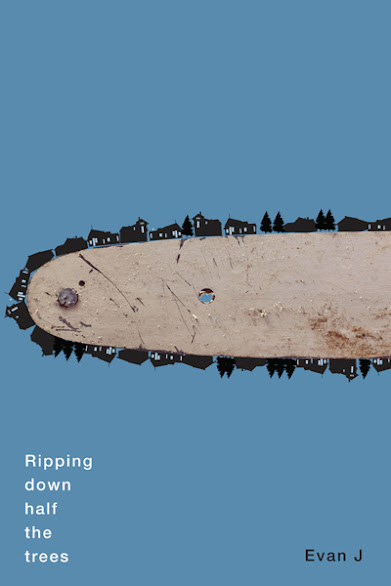
Ripping down half the trees, Evan J.
McGill-Queens Press, 2021


Evan J’s debut collection, Ripping down half the trees, is one that travels from Southern Ontario, to Manitoba, and then even further north to Thunder Bay and Sioux Lookout, where the poet now lives and works in the field of adult education. In the very first poem in the book, “Bloor-Yonge,” Evan writes of Toronto, of “the blank passive everyones” who are “maddened to escalator” while the “full-timer subway hustlers” consistently and plaintively ask passersby for help. Later, in poems like “If Homelessness if a Sandwich, Our Culture of Silence is the Bread” and “Note to the People Using Old Needles Stolen from a Public Bathroom,” the poet is acting as a witness to the life that teems around him, pointing out the racial and social inequality that continues to exist across Canada.

Evan situates himself as a white cis-man, settler, and teacher by being sure that his readers are clearly aware that he very much knows what it is that he carries with him to these new places in which he lives and writes. In “Beyond Ear But Open,” he writes, honestly: “I am boy, your jeering tongue dubbing me/Evan Almighty because I appear weekly/with all the whitest toys for learning.” In the brilliant poem, “Colonialism for Dummies,” Evan speaks to other settlers who might make excuses for their ancestors’ historic colonization of this country: “You can call your ancestor’s passage an invasion, I mean/an exodus, a historic flight from poverty or famine or/communist murder.” He continues to write “…be sure to vocalize your distance from the violent and oppressive acts” until it is easy enough to justify shooting “a Cree man in the head, I mean murder, and go/unpunished.” What the poet is doing, throughout so many of the poems gathered in Ripping down half the trees, is drawing attention to the settler tendency to explain away systemic racism that has been rooted in Canadian history for hundreds of years. He holds a mirror up so that the reader needs to look inwards to their own sense of privilege, as well as outwards towards the poetry.

Structurally, there is a powerful series of “How to” poems that are woven throughout the collection. In “How to Clean Walleye,” Evan begins with his tongue in cheek: “Use soap. Just kidding. Use a boulder waist-high as a/butcher table. Lay the fish sidelong, backbone across your/belly.” In “How to Stay Alive on the Streets of Sioux Lookout,” Evan’s tone shifts as he writes: “Keep a distance from most white folx./Finish dirty jokes in Oji-Cree./Keep your feet moving when the OPP patrol./The Kenora Jail is worse than cold or hunger.” Further on in the book, in “How to Fly Home,” the poet writes of a homeless man in Northwestern Ontario whose name is Mike and who “is a survivor, and if lucky/around midnight he will sleep rough and alive beneath a/totem of capital failures, a hungry homeless head on cement/just inches from banknote pillars, the pillows of green queens.” As a reader, you simply cannot turn away. In some cases, you may only be able to bear reading one or two poems at one time, just because the pain can feel that palpable and tangible—something which speaks to Evan J’s skill at recording very difficult things in his poems.

If you’re from the north, or you’re familiar with small northern towns, you’ll know that they aren’t simple things. They have histories that stretch back in time, and usually revolve around resource extraction. Some of these places are the mining and mill towns, and the tiny places marked on folded CAA paper maps that used to live in the glove boxes of family cars. When you read Ripping down half the trees, if you’re a northerner, you’ll feel the harsh truth of it all, recognizing the stories of people who you’ve likely seen on your own hometown’s streets—knowing that colonialism, social inequality, and systemic racism haven’t disappeared, but have only rooted down more stubbornly into the earth. Through Evan J’s poems, these social injustices are highlighted, opening spaces where important conversations need to be taking place.  


Kim Fahner lives and writes in Sudbury, Ontario. She was poet laureate in Sudbury from 2016-18, and was the first woman appointed to the role. Kim's latest book of poems is These Wings (Pedlar Press, 2019). She's a member of the League of Canadian Poets, the Ontario representative of The Writers' Union of Canada (2020-22), and a supporting member of the Playwrights Guild of Canada. Kim can be reached via her author website at www.kimfahner.com

Friday, November 26, 2021

James Yeary, Vanessa Jimenez Gabb, Monica Mody, Jenny Drai + Ben Robinson : virtual reading series #27

a series of video recordings of contemporary poets reading from their work, originally prompted by the Covid-19 pandemic and subsequent cancellations, shut-downs and isolations; a reading series you can enjoy in the safety of your own protected space,

Ben Robinson : “Low Vacancy”

Ben Robinson is a poet, musician and librarian. His most recent publication is Without Form from The Blasted Tree. He has only ever lived in Hamilton, Ontario on the traditional territories of the Erie, Neutral, Huron-Wendat, Haudenosaunee and Mississaugas. You can find him online at benrobinson.work

Jenny Drai : “Wulf and Eadwacer” (translated from the Old English) and “Wide Tracks”

Jenny Drai is the author of three collections of poetry, including Wine Dark and The History Worker from Black Lawrence Press and [the door] from Trembling Pillow Press. More recently, her short fiction has been published in Alaska Quarterly Review and Pleiades, where she was awarded the Agnes B. Crump Prize for Experimental Fiction, as well as other journals. She is online at jennydrai.com and lives in Dortmund, Germany.

Monica Mody : “Ordinary Annals”

Monica Mody is the author of Kala Pani (1913 Press), the forthcoming Bright Parallel (Copper Coin), and three chapbooks including Ordinary Annals (above/ground). Her poems have appeared or are forthcoming in anthologies including Extinction Violin: The Penguin Book of Modern Indian Poets, What is Time: An Anthology of New Indian Writing, Hibiscus: Poems that Heal and Empower, and &Now Awards 2: The Best Innovative Writing. Her poetry also appears in Poetry International, Indian Quarterly, Almost Island, Boston Review, and other lit magazines. She has been a recipient of the Sparks Prize Fellowship (Notre Dame), the Zora Neale Hurston Award (Naropa), and a Toto Award for Creative Writing. Monica was born in Ranchi, India, and lives right now in San Francisco – Ohlone territory.

James Yeary : “The Fishes”, “Neptune’s Back”, “The Sky at her Furthest”

James Yeary is a Portland-based poet, artist and publisher. Since 2008, he has collaborated with Nate Orton and Chris Ashby on the long-running site-based zine series My Day, which is approaching its fiftieth installment. He has published a number of books and objects under the names c_L books and spitch, the latter of which will be issuing a career-spanning collection by Sotere Torregian. The chapbook The 66,512 (written under the nomdegwar Urie V-J) is forthcoming from above/ground. 

Vanessa Jimenez Gabb : an excerpt from the “You and Me, Forever” section from Basic Needs

Vanessa Jimenez Gabb is the author of the poetry collections, Basic Needs (forthcoming October 26, 2021, Rescue Press) and Images for Radical Politics (2016, Rescue Press). She is from and lives in Brooklyn, NY. More at vanessajimenezgabb.com

Monday, November 22, 2021

2021 bpNichol Chapbook Award shortlist interviews: Matthew James Weigel

It Was Treaty / It Was Me, Matthew James Weigel
Vallum Chapbooks, 2020
2021 bpNichol Chapbook Award Shortlist
 

The 2021 bpNichol Chapbook Award will be announced on Thursday,November 25, 2021.

Matthew James Weigel is a Dene and Métis poet and artist pursuing a PhD in English at the University of Alberta and holds a Bachelor of Science in Biological Sciences. He is the designer for Moon Jelly House press and his words and art have been published by people like Arc Poetry Magazine, Book*Hug, The Polyglot, and The Mamawi Project. Matthew is a National Magazine Award finalist, Cécile E. Mactaggart award winner, and winner of the 2020 Vallum Chapbook Award. His debut full-length collection Whitemud Walking is forthcoming in early 2022 with Coach House Books. His chapbook It Was Treaty / It Was Me has been shortlisted for both the bpnichol Chapbook Award and the Nelson Ball Prize and is available now.

It Was Treaty / It Was Me is your poetry debut. How did the project begin, and how did the form of the poems emerge? How were the poems formed?

There were two starting points. One was how, as a kid, my dad would always tell me how grandpa signed treaty. It was really important to him that I know and be proud that our ancestors were involved in that process. And the second was February 2019 when I first saw the University of Alberta's copy of the Treaty 6 parchment in our library and archives special collections. There is this big mystery about how and when it was printed and how it was never delivered to the signatories as promised. I was drawn to this mystery because as a kid I had that connection to treaty but those kinds of connections had been disrupted in this case. If the stories are sequestered, the connections inherent in these living agreements can be relegated to the past and manipulated. The government's obligations can be ignored and that can go unchallenged. It just so happens that in the course of my work those disruptions continued to take a personal toll as I would find family connections to items in the collections. So the themes of the chapbook are built around this idea that I was being gradually collected by the university and other institutions. The poems are about the interconnected relationships of treaty, the land, and the body, and how archival violence is a special type of colonial violence. In terms of form, my work often blurs boundaries between visual art and writing, and with a background in science I have a fondness for figures and diagrams that can be quite poetic in how complex ideas are explained elegantly and succinctly. It's important to tell these stories in ways that resist 'conventional' methods and poetics, it's a form of resistance in its own way.

Part of what is so compelling about the chapbook is the way it exists as a form of resistance. Had you any specific models when you were putting together this work? Were there any other poets or works in your head as you wrote?

Oh definitely! I think there's a lot of conversation between the works of Indigenous poets writing today. Folks are all reading each other's books and I'm no different. Marilyn Dumont is someone I really look up to, and her work is so critical to revisit and sit with. Especially The Pemmican Eaters. Lisa Bird-Wilson's The Red Files is especially vital as a work that parses archive and documentation. Layli Long Soldier's Whereas might be a book I would call a model, it's an extremely complex and powerful text that is also very wide-ranging in its sources and forms. Joshua Whitehead's Full Metal Indigiqueer is a book that always makes me immediately want to write something. Billy-Ray Belcourt's writing in general is also so layered, generous, joyous. Liz Howard's work always makes me push how I think about language. I'm  definitely always trying to think through Jordan Abel's work. As a visual poet, he's just at another level in how sharply he creates work about the land. Other writers I was reading a lot were folks like Claudia Rankine, Mercedes Eng, Douglas Kearney. But the storytelling and spoken word aspects of my work are really important to me as well, so some of these poems had their start at the microphone. In that regard, poets and performers I really look up to are folks like Hanif Abdurraqib, Titilope Sonuga, and of course my partner: Nisha Patel. I hear Nisha's work more than anyone's, she's continuously amazing me.

It Was Treaty / It Was Me feels very much like it could potentially be part of something larger, potentially book-length. Do you see this work self-contained, or has it a shape larger than what we’ve seen so far?

That's interesting you see that! It's definitely not self-contained and is absolutely part of larger works. Something I've struggled with in my work is considering it finished enough to present to others. But I have to get over that! When the work I do is so intertwined with treaty – which is a concept fundamentally boundless, eternal, multi-faceted and multi-layered – so it's not the type of creative work that can be ever finished. That work often takes the form of writing, but I've done some complex visual art as well. I even make multimedia artist's books, pop-up books, and glass etchings. I'm always looking for new ways to tell these stories. Also my creative work is just one part of the work I do in telling stories about this place, and about treaty. I love doing classroom visits because people often have a lot of questions about these topics that are not talked about in school and university. That sort of outreach work I do is always ongoing and I'm always learning and refining. Each interaction with a person, each reader or each listener, is a new connection. As that happens new perspectives on the work emerge, new layers, new elements. When I started on this project Janet Rogers actually said to me "you know this is your life's work now, right?" and I take that very seriously. It's not work that I can ever finish. I have to keep honoring the relationships by sharing the stories and knowledge I have. Treaty is about reciprocity and obligation, I take that very seriously.

You’ve a full-length debut scheduled for the spring with Coach House Books. How do the poems in It Was Treaty / It Was Me relate to the work in the forthcoming Whitemud Walking?

Whitemud Walking builds on this work and pushes it in a lot of different directions. I expand on my relationship with the University of Alberta, the city of Edmonton and the Strathcona neighborhood. The chapbook is an entry-point into a lot of complicated conversations about how Canada attempts to extinguish Indigenous title to land, and how that's a multi-layered and ongoing process. That's a process that's tied up in resource extraction projects like the fur trade, the railroad, the archives, and academia. So a lot of the threads in the chapbook are followed a lot further in Whitemud Walking. And I suppose I shouldn't be, but I keep being surprised at how those threads so often wrap around my family history.


Thursday, November 18, 2021

2021 bpNichol Chapbook Award shortlist interviews: MA|DE

A Trip to the Zzoo, MA|DE
Collusion Books, 2020
2021 bpNichol Chapbook Award Shortlist
 

The 2021 bpNichol Chapbook Award will be announced on Thursday, November 25, 2021.

MA|DE is a collaborative writing entity that was co-founded in 2018 by artist/designer/poet Mark Laliberte and writer Jade Wallace. MA|DE's work has appeared in dozens of journals including Vallum, Poetry is Dead and PRISM International, and has been collected in three chapbooks. With the support of the Canada Council for the Arts, MA|DE is currently at work developing their Collusion Books chapbook A Trip to the ZZOO into a full-length poetry manuscript, to be titled ZZOO. Visit us at: ma-de.ca

Twitter and Instragram.

A Trip to the ZZOO is the second of three published collaborative chapbooks. How did the project begin, and how did the form of the poems emerge? How were the poems formed? 

A Trip to the ZZOO was born out of our earliest writing together as MA|DE. That was a time when we wrote quickly, exuberantly and without much of a plan, other than to explicitly frame everything we produced under a blended moniker that represented our joint authorship.

We worked on several poems at one time: one of us would write a line or two to begin, the other would add to take it further along, and then it would be returned, an oscillation; we broke our patterns as often as we adhered to them, interjecting lines wherever they fit or forcing them in to complicate things, to avoid a sense of strict pattern. Basically, it was a kind of chaotic, back-and-forth building. When we had nothing else to say, we would stop and move on to new poems.

Many of these early poems were picked up by literary journals, and we dimly thought we might one day try to make a book, but with no specific plan to do so. It wasn’t until Collusion Books came into being, with its collaboration-focused mandate, that we first thought seriously about how we might turn our growing pile of disparate works into a cohesive chapbook. Reading through the dozens of poems we had written to that point, we noticed a certain creaturely motif in high concentration (perhaps one of every four works in the archive) that we hadn’t been aware of as we were writing. We brought all of those animal-adjacent poems together and found we had enough for a small collection, A Trip to the ZZOO, and thankfully Collusion took it on.

I know you’re working towards a full-length manuscript, but do you approach each chapbook as a self-contained work, or are you excerpting from your manuscript-in-process to create chapbook-length manuscripts? What is your unit of composition? 

We feel there are two reasons to publish a chapbook: to capture something self-contained — Test Centre (ZED Press, 2019) falls into this category — and to concretize a moment along the path to a larger work. A Barely Concealed Design (Puddles of Sky, 2020) and A Trip to the ZZOO both represent this latter kind of thinking.

In the case of the animal poems, once they had been accepted for publication as a chapbook, we thought, well, why not a book? We realized we wanted this chapbook to be a gate that would lead somewhere bigger, so we titled it in a way that hinted at a larger whole. The full ZZOO manuscript is still in progress at the moment, and we were deeply fortunate (and surprised!) to receive a grant from the Canada Council for the Arts a few months ago to complete the project. Currently, we are collecting articles & ephemera related to animals to give us some jumping-off points into new poems … the writing is more territorially defined now, and so we’re trying to wander a bit less. As we work to complete the book, we feel we know where we’re going.

We have never envisioned the poems as animal-gazing spectacles. The odd spelling of ZZOO is a signal to the reader that this is not your traditional zoo; instead, what we are trying to do is find new ways of looking at animals. Our gaze might always be human, but that doesn’t mean it has to be voyeuristic or exploitative. Instead, these are poems about perceiving humans & animals as integrated parts of the same world. We are all living in the ZZOO.

How does this collaborative project interplay, if at all, with your individual works? 

Our individual works take us to completely different places most times. Mark makes experimental comics, visual poetry; he’s recently been exploring haiku. Jade just wrote a novel! While the ZZOO project may overlap thematically with some abiding concerns in our individual works — Jade, for instance, explores ecocriticism and ecopoetics in fiction as part of their solo practice — it really is a body of work that decisively belongs to MA|DE. We have always seen MA|DE as an entity unto itself. If you read the poems, we suspect you will be hard-pressed to identify which lines were written by Mark and which were written by Jade; sometimes we can’t even look back and identify our own paths through the writing accurately. Our poems are not a dialogue between two voices; MA|DE has a voice of its own. And this is not a one-off collaboration between two solo practitioners, but an organism we intend to sustain long-term.

Having said that, the pandemic has opened up some surprising individual/collective overlaps here at our home base. We’ve had a lot of time on our hands to contemplate, rationalize, explore; and ironically, even though ZZOO remains a pressing work-in-progress, at the start of 2021 we also began to develop our next major body of writing.

Waste Not the Marrow is a hybrid manuscript that fuses visual & textual elements and blurs the lines between our solo & collaborative work. The visual side of things focuses on presenting complicated, vertically stacked collage-sculptures, some of which Mark was working on long before MA|DE existed; these artworks were accumulating in the studio, but never really had a raison d’etre (for whatever reason, he’s never felt comfortable showing these particular works in gallery scenarios) until we decided MA|DE could/should/would write to them. So they function both as his solo works and as our starting point: strange objects that we are exploring & animating through language, kind of an exercise in self-ekphrasis but also a real push into hybrid territory.

Have you any models for the kinds of work you’ve been attempting?

Collaborative writing, while being a time-honoured practice (consider, for example, the Japanese collaborative form renga, which likely dates back to the sixth century), remains a rapidly-expanding field, which is thrilling both to watch and to be a part of.

In terms of what we’re attempting with MA|DE, we sometimes feel positioned at a somewhat odd angle when comparing ourselves to other writers interested in literary collaboration. We love what someone like Gary Barwin is doing for the scene; he seems eager to collaborate with multiple writers within his circle — recent projects have popped up with derek beaulieu, Gregory Betts, Penn Kemp, Tom Prime — and the publications he produces through these collaborations have a playful, inventive streak that always excites. There is an element of jazz/improv to what he pursues, the literary equivalent of getting a few talented people into a studio, pressing record and then seeing what happens (at least that’s our take on the writing). This seems representative of the most common approach to collaboration at the moment, which is to compose as a duet where the individual voices are left clear, willingly exposed. We understand the joy in that approach.

By contrast, however, we are most crucially looking to establish a singular voice for MA|DE, to seek what William S. Burroughs called (in relation to his collaborations with Brion Gysin) a third mind — “the complete fusion in a praxis of two subjectivities, two subjectivities that metamorphose into a third”. This is something that’s hard to manifest, and it can only be nurtured over time.

From that vantage point, many of the models that we most admire seem to exist outside of the field of literature, long-form collaborations that seem to be more common in the art world. For some excellent Canadian examples, we look to the bodies of work developed by General Idea (active from 1967 to 1994, comprised of AA Bronson, Felix Partz & Jorge Zontal), Public Studio (the multidisciplinary, collaborative practice of filmmaker Elle Flanders & architect Tamira Sawatzky) and FASTWÜRMS (the cultural project, trademark and shared authorship of Kim Kozzi & Dai Skuse — who, incidentally and influentially, were Mark’s MFA thesis advisors at the University of Guelph).

most popular posts