Foreword:
The Essential Eugene McNamara. Selected by Phil Hall.
The Porcupine’s
Quill, 2022
Windsor,
Ontario, is a strange city. Sometimes called “South Detroit,” it has an
end-of-the-road langour, and seems islandish, smaller than it is—a motor
manufacturing town, a whisky town, a university town. It has an old French
population, and French street names (Ouellette Ave). Many names honour its
First Nations (Huron Line, Tecumseh Rd, Wyandotte St). Reached from the
south—as an end of the Underground Railroad—it meant freedom.
Eugene
McNamara’s poetry absorbs and ponders the textures and contradictions of his
adopted city: tankers honking on the river at night, the proximity to all that
America is, the smell of malt sugar brewing, Riverside Drive, Dieppe Gardens.
McNamara was a Windsor poet, a Canadian poet, a novelist and short-story
writer, a professor of literature and writing.
He
was the first real poet I ever met. When I moved to Windsor in 1972 to attend
university, there were poetry readings in the back of the Student Centre. PK
Page, Tom Marshall, Patrick Lane, Al Purdy, Robert Kroetsch and Alden Nowlan
visited. I saw Gene as a coordinating force among these luminaries.
Joyce
Carol Oates came as an early recruit to the English and Creative Writing staff
at Windsor. Alistair MacLeod, the great Canadian short story writer, was also a
professor in Windsor, and a long-time friend of McNamara’s. Peter Stevens
taught Canadian Literature, John Ditsky—American Literature, Rick Hornsey—the
undergraduate writing workshop. All three were poets. And Marty Gervais,
another poet, was starting Black Moss Press, while working as a journalist at
the Windsor Star. These were McNamara’s colleagues and compadres.
In
graduate school, I was in Gene’s poetry workshop with Bronwen Wallace and
others. And I took a graduate seminar with Joyce Carol Oates—she was also a
poet, and a fine teacher. Tom Wayman came as writer-in-residence, and Wayman
was a big influence on both McNamara and myself.
Stevens,
Ditsky, Hornsey, Gervais, Oates, Wayman and Wallace were all important first
poets to me. But McNamara was the core model, and remains so. After I left university,
there were times in the 80s when Gene and Len Gasparini—they were old
friends—and I would meet at a diner in Toronto and spend the afternoon talking
about poetry and Windsor.
An
academic approach will not do this work justice. Although a literature
professor, McNamara found poetry—right from his first book—to reside in small,
non-eloquent, delinquent, unpopular and wayward places. The people who speak in
his poems are undistinguished and almost without voices. The words they use are
small words. He is not afraid to touch the rawest, cheapest emotions.
He
performs structures of emotion in his poems that every teacher of creative
writing (and of course he was one) tells young writers not to make the mistake
of using. It can be almost embarrassing to read McNamara, until we consider how
simply and with what risk his poems are built. In his poems there is a
disarming exposure to something that feels like—and we surprise ourselves
realizing this—holiness. Homemade monosyllabic holiness.
McNamara
does not intellectualize—he empathizes. Outlaws, factory workers, circus
performers, matinee idols and movie goers (chewing their shirt collars)—all
populate these poems. This poet stands with the lovelorn, the lonely, those
driving at night by themselves, singing along to the radio. In “Your Small
Voice” he “traces over meridians of / desire so desperate no one / else will
touch them”. Searching in alleys and gullies, poking at abandoned detritus,
McNamara finds, again and again, the same abandonment in which to seek
salvation, and the same reasons to doubt himself.
There
is a transformative moment that McNamara tries for, and returns to over and
over. He gets there by using the same words and flowing method repeatedly.
Revelation and assimilation are sought and found and lost. Admirably, this
breadth of hoped connection is realized by the use of an extremely narrow
palette—words as single notes (do re me fa so)—few words, thinly, down a page
(a rush as thought drifts)—repetition, the same locations and situations, night
thoughts and confused dreams, old half-memories.
This
moment is also a tone. The way a poem by Gerald Stern or William Stafford can
only be by each of them because of a signature tone, a poem by McNamara is
recognizable as only his because of his tone, his mood, his descending moment
and sound. “Elevating Device Licence”:
a man standing under empty sky
with his empty hands hanging
down having thought he heard
something like music and he
feels foolish and alone
Because
there is almost no “content” in poems like these, readers may get scared. We
don’t know where the poems are going, or what they might say next. They risk
the edge of indulgence to offer us a common membership in resilience and
reverie.
The
second poem in McNamara’s first book (For the Mean Time, 1965) catches a
small hushed moment during an “Afternoon Seminar”:
Out of the day’s turbulence
This time of postured quiet
This space of calm,
All energies spent.
Yet here in this circled moment
I find etched presagings
Of scorn to come.
This
makes teaching sound sensual. But it is that last line that surprises—that word
“scorn” seems to come out of nowhere. Then, reading the arc of this
poet’s career, it begins to fit right in. One of his late poems here has Jesus
crouching (like Tom Joad) to write the poet’s name in the dirt as a message to
us all.
Film
is important to these poems—vision, method and obsession. McNamara, early on,
was a script writer. (One co-written script, Rebel Territory, sold to
Sammy Davis Jr, was going to be Hollywood’s first “Black Western”, but never
got made.) My selection opens with a brief sampling from Love Scenes (1970),
a long documentary poem (that had nude line drawings along the pages). Here
too, the familiar themes and methods are found.
Vaudevillian
buffoonery is combined with a love of how things worked in the poet’s youth,
how film in a camera used to wind, how tough guys and gals spoke about sex,
what friends or parents said in their final letters or dream-visits. The past
is a mulled-over recurrence to wake from. Going back there is how a poem loses
itself and leads us into its hypnotic surprises.
There
is a pervading respect for language as imprint and sound. This can go
unnoticed, because the dexterity of language-use is always humble, and
blatantly un-portmanteau. There is no showing off of vocabulary, and no
parentheses. The sentences do not work by an embedding of asides or clauses.
Between one line and the next we may change sentences without warning. There is
an accumulation of plainsong—pointillism made with word-steps.
From
the start, McNamara did not trust punctuation, even unto using no apostrophes
in contractions. The effect is to set each word down as dry stone. But not dry—because
emotion is flooding these structures. The poems are columns that flow. And
there are few caesuras. Maybe the words
in the poems are notes not stones, grace notes in a score to a song. He was
making music—not argument.
He
used the lower-case first person pronoun for almost his whole career. The
“i” keeps its head down to take part in
the flow. When it became unfashionable to use E. E. Cummings’s “i” McNamara
still used it. Then in later poems the posturing of gender loosens as
well—someone wider and more representative is talking. Who is doing hard labour
with a wheelbarrow, or a jackhammer? This poet worked with books, so who is
talking? Surely it is McNamara the lover, father, husband, son, and friend
talking throughout—but it is also not quite him—a doppelganger, a voice, voices,
characters someone, us...
Sure,
there was always a hint of arrogance in our use of that lower case “i”. The
wink of using it said we knew enough to use it. In McNamara’s last poems
the capital ‘I” returns, and by that more common way of pointing to the self
the speaker seems even more like us than he did all along, less artistic but
more at peace, punctuating like everyone now, almost indifferently. A few
dashes, periods—but he will leave out the apostrophes, or maybe not. By these
few marks, the poems slow down. There are wider and briefer stanzas, one line
stanzas, each line a separate mind-move.
The
fiction writer in McNamara was always drawn to characters: Dillinger, Roy
Orbison, Richie Valens, Perry Mason, Clifton Webb, Joan Crawford, Amelia
Earhart, Alice Faye...Some of these dazzling but rough souls are out of fashion
now, and some of the poems they are featured in are not au courant. But
the way a woman on a street corner says “lisson” still comes through as
haunting, funny, authentic—two slow equally-stressed and challenging syllables.
McNamara
was in origin an American, and an Irish Catholic—this is important. American
place names resound through his poems. The blarney is not overt, but being
Catholic increasingly mattered—until we may call McNamara, ultimately, a
religious poet. This will come as another surprise to those who remember his
tough poses in early books. Under aggression there was always the lost boy, the
guilty seeker, worn out and begging mercy, craving unity. His last poems speak
of the canonical hours, reading, classical music, gratitude and redemption.
This is not a make-over—these tendencies were in his poems all along. I am not
arguing for sainthood—Gene wouldn’t want that.
One
of the last times I was in Windsor while Gene was still alive, I was scheduled
to read with him at a Festival event, but he was too ill to attend, and I
visited him later. Marty Gervais took me over to the McNamara home. Gene used a
walker on wheels, but that Irish playfulness was still in his eye, & the
supportive humour of his conversation still shook me. As always, his wife
Margaret was very kind to me also.
Gene
kept bringing his best poems forward and reshaping them into later books. He
found a late acceptance of periods—or dashes are used instead of periods. There
are inconsistencies in all of his rare uses of punctuation—inconsistency is
character.
An
early poem might show up as a prose poem in a new sequence. An older poem
reused in a different book may seem like a work poem now, where before it
didn’t. A word in a line may have vanished. Even a late comma or two might
sneak in, for pacing. The biblical adjective for Gene’s kind of stonework would
be “unhewn.”
It
is as if Gene were reorchestrating an exhibit of the same favourite weathers—to
best represent, in the best arrangement, a lifetime. I have checked all
versions and adjusted what was glaring—to offer the most consistent usages—so
that the poet’s laconic vibrancy stays evident.
As
with the best films—such as Gene’s favourite film, Laura (1944)—I hope
the reader is not left studying the smallest credits, but may leave the theatre
remembering and humming the overture.
reprinted with permission
from The Porcupine’s Quill, Inc.
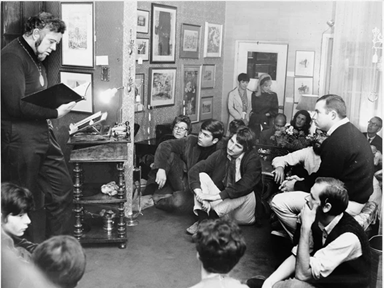
photo of Eugene McNamara
from the archives of the Windsor Star
Phil Hall
has been publishing poetry in Canada for 50 years this year. His most recent
book is The Ash Bell (Beautiful Outlaw Press, 2022). Forthcoming this
fall: Vallejo’s Marrow (Beautiful Outlaw Press, 2023).