Showing posts with label Pinhole Poetry. Show all posts

Thursday, October 1, 2026

Kim Fahner : A Mudlarker’s Diary, by Ariel Gordon

A Mudlarker’s Diary, Ariel Gordon
Pinhole Poetry, 2026


Anyone who follows Ariel Gordon on social media (IG @janedayreader) will know that one of her passions in life is mudlarking. If you aren’t sure of what it is, mudlarking is something that started in 18th century London, along the River Thames. Contemporary mudlarkers go out to the edges of rivers and sift through mud to find what lies beneath. Bits of bottle glass, pieces of china cups and saucers, cast off buttons, and shards of ceramics. In London, you need a permit to go mudlarking and you are not permitted to re-sell your finds. For Gordon, Winnipeg’s Red and Assiniboine Rivers are the places she most often goes to search out the past, often with other mudlarking poet friends who share her passion.

The poems in Gordon’s newly released chapbook, A Mudlarker’s Diary, document her riverside adventures from June to October 2023 and mark the river level of each visit to a shoreline. In the first poem, dated June 1, Gordon writes of “slip-n-slide footsteps” as she and fellow poet-mudlarker, Sally Ito, “chase geese/from beach to beach, yellow goslings herded/between black & white//goose & gander.” They move past encampments of unhoused people while Gordon discovers “the biggest chunk//of poison bottle I’ve ever found,/its blue glass sides studded w/ hobnails/& embossed along//one edge: NOT TO BE TAKEN.” Later, further along the shore, the poet finds the remnants of a dead fawn, “its speckled hide attended by flies,/not mauled but somehow folded/wrong.” Returning later that same year, Gordon finds that the carcass has gone, dragged off by some hungry creature.

Throughout the poems in this collection, Gordon refers to river pollution, referencing “Floating condoms, yes, but also ducks/w/ gasoline heads” and speaks of how the river has become “full of effluent,” a place where Winnipeg garbage has been dumped for generations. Despite the brightly coloured plastic tampon applicators and broken chunks “of red bike reflector,” Gordon is hopeful in her work. She writes of the birds and insects that live along the rivers, from “Black & white winged//grasshoppers, butterfly mimics” that “fling themselves into the air” to “hungry gulls,” a “yearling//deer, its back still spotted,” and a bird that “called beautiful warnings//all summer.” The poet walks near to “mobs of geese/& ducks,” birds that ignore her because she ignores them, with her “eyes fixed on my feet.”

This mudlarker poet converts “settler garbage, smashed status/symbols, into finds,” searching out the history of “an embossed medicine bottle” that was found “under a rock: John W. Bennie,//Dispensing Chemist, Polmont Station” to later discover that the pharmacy where it originated “was at a train station between Glasgow/& Edinburgh & dates it//back to the early 1900s.” This information, sussed out on the internet, has the poet thinking about “someone/tucking it in their luggage, next/to their immigration papers…”

After journeying through Gordon’s A Mudlarker’s Diary, a reader finds herself thinking of how humans have always created refuse, just from having lived in various spots. From ancient midden heaps dug up by archaeologists to these more recent finds documented by Gordon along the riverbanks in Winnipeg, we are here for such a short time but leave behind clues to our existence.

What’s also present in A Mudlarker’s Diary is an awareness of how social class is reflected in the refuse left behind by humans in the rivers and shorelines, but also highlights Gordon’s views of the landscape as she moves by inhabited and abandoned encampments while seeing the wealthier houses in the distance. This is not simply a poetic documentary of what’s been found during a series of mudlarking outings, bur rather a witnessing of what has been—and what is now—and a call to action to pay attention to both the landscape of the natural world and the people who have inhabited it.

The cover of A Mudlarker’s Diary is appropriately mud-coloured and some of the finds mentioned in the poems are visible inside the chapbook as drawings. These illustrations are taken from Gordon’s photographs of her mudlarked discoveries, and the delicate rice paper flyleaf features embossed finds that she stamped with ink. This is, to be sure, another fine chapbook released by Pinhole Poetry’s brilliant publisher, Erin Bedford, who’s curating an important body of Canadian poetic work in both her online journal and in this poetry chapbook press. All of these gorgeous chapbooks can be purchased online via Pinhole Poetry’s website.


Kim Fahner lives and writes in Sudbury, Ontario. Her most recent books include The Pollination Field (Turnstone, 2025) and The Donoghue Girl (Latitude 46, 2024). She is the Chair of The Writers' Union of Canada (TWUC) and recently won first place for her CNF essay, "What You Carry," in The Ampersand Review's 2024 essay contest. Kim may be reached via her author website.

Monday, September 1, 2025

Kim Fahner : Flight Problems: The Amelia Earhart Poems, by Paula Eisenstein

Flight Problems: The Amelia Earhart Poems, Paula Eisenstein
Pinhole Poetry Chapbook Press, 2024


To begin with, a confession: I have always been transfixed by the story of Amelia Earhart. That she was so much a woman who came before her time, in terms of the life she chose to live, and that she just disappeared without a trace, is a mystery that begs to be explored. My friend, Matt Heiti, has written a play about Earhart called Ever Falling Flight, and I loved Lindsay Zier-Vogel’s novel, Letters to Amelia. Before I even saw Heiti’s play, or read Zier-Vogel’s novel, or Paula Eisenstein’s Flight Problems: The Amelia Earhart Poems, I remember doing curious Google searches on her when I was much younger, wondering if recent photographic ‘finds’ over the years would pan out to become ‘the real deal’ when it came to finding her last resting place and that of her beloved plane, a Lockheed Electra.

Eisenstein begins her chapbook collection not with Amelia Earhart’s youth, but with a poem that conjures the time of her celebrity and fame—a time filled with flashbulbs and public appearances across North America. In “Winter of ’33,” the poet crafts a poem that moves across the page, writing about how Earhart’s “primary source of income/[was] coming from lecturing,” and how she “drove over seven thousand miles in six weeks/mostly alone/giving at least one interview at each stop/as well as the lecture.” At the end of such a harrowing and exhausting tour, Earhart “rented a modest house/in North Hollywood near Toluca Lake,” telling the media “she was on vacation.” Throughout the poem, Eisenstein braids in the image of “a butterfly pupa/going through a phase of life/to activate transformation.” The end of the piece is haunting, as the poet leaves the reader with the idea that “The pupal stage/lasts weeks, months, or even years/depending on the climate and insect species.” In contrast to today’s media (over)exposure of celebrities, Earhart’s encounters with the press and public seem tame, but—for her—were likely rather intense.

The poems that populate the early part of the collection refer to Earhart’s childhood—of how she moved between her parents’ Kansas City home and her maternal grandparents’ home in Atchison,  Kansas, a place where “Gauzy bedsheets/the dead once crept in/bloom in the wind/on the clothesline.” They also refer to her father’s struggle with alcoholism, and to her parents’ very rocky relationship. What is solid throughout this cluster of poems (and her life) is Amelia’s relationship with her beloved sister, Muriel. They “run worm races” together, making “a harness from a grass//blade, a sulky/of a small leaf.” In playing these imaginative games, young Amelia feels able to fashion some sense of control over her life.  

Eisenstein touches upon Earhart’s time as a nurse in the poem, “Toronto nurse succumbs,” writing of images that include open and decaying wounds, “bleeding stumps,” “bedpan chores,” as well as references to “the surgeon’s path” and “A cure that torments/and does not work.” When Amelia’s mother returns to her husband, in California, Muriel and Amelia follow, but, in “California,” Amelia (as the speaker) says, “Me,/I too am free like the black-capped chickadee//chick, that set off in fall to join a new flock,/about which studies show//no evidence of parental recognition/after the first year.” From there, Flight Problems moves into the flying poems. In “Opportunistic Cuckoo Egg,” Amelia’s voice speaks to the reader through time and space. She decries the addition of a man to her flight, saying “the reason: I/am a girl: I/am a nervous/lady: I might throw//myself out.” The man is just someone who’s been added to the flight to be sure that Earhart is protected, simply because women weren’t often pilots in the 1930s.

The poems recollect, and almost dovetail, the upset and struggle within Amelia’s family life. In “Preening,” the idea of Amelia purposefully creating an image or illusion is pointed to as including “riding breeches, lace up boots,//a well-tailored/jacket.” To complete the image, a “library book/on practical/aeronautics” is tucked under her arm. Cloudy skies in “Fly days” are compared to “our parents’/dog sick marriage,” and in “Mother leaves father, returns to Boston. So do I,” the reader begins to understand that Earhart was not impressed by the idea of marriage: “The doctor says that scientifically/he can make me/fall in//love. I don’t want to./There’s something wrong with me.” That doctor compares Earhart to a “caged mynah bird,” but what she feels to be, to this modern reader, is someone who was simply born before her time. She had a dream, a wish, and she set out to make it real.

A series of creatures with wings—both birds and insects—make their way through the poems in Flight Problems, further drawing a connection to Amelia Earhart’s own love for flying. In “Satin Moths,” “the spring lock of the cabin door breaks./The door hangs open like a mouth.” The people who are struggling to close the door, then, are referred to as clinging “like the satin moths//that swarm around the willow trees at dusk/in June July and August.” In “Passenger Pigeon,” the voice of AE (Amelia Earhart) speaks to her fiance, George Putnam: “your protective nature…reminds me/of an African Wild Dog.” She concludes, firmly: “know this:/I would rather dream./I would rather do. I would rather fly.” On the day of her wedding, in “Cowbird (Feb 7 1931),” the poet writes: “She kept her own/name though did not mind Mrs. Putnam/socially.” In “Black Swan,” there is, again, the recognition of how feminist Earhart was during a time when feminism was derided: “A girl can be/any one/she wants to be.” To fight against the cult of domesticity in the 1930s, to be the exception to the rule, would have been difficult, and sometimes I think maybe Earhart found freedom from the too strict conventions of a patriarchal society while she was flying her plane and breaking aviation records.

I reached out to Paula Eisenstein to ask her about her fascination with exploring Amelia Earhart’s story through the poetic form, mostly because of my own interest in the mysterious tale. She responded by telling me that she wanted “to have a heart-to-heart conversation with an imaginary Amelia” in her mind. That ‘imaginary Amelia,’ as Eisenstein calls her, “had no qualms with the kind of energy I wanted to bring to this project. She wasn’t fazed by my desire to investigate the less seemly parts of her life.” There’s so much of the element of ekphrasis in this poetic undertaking that Eisenstein calls Flight Problems: The Amelia Earhart Poems, as the poet explores a very well-known woman’s life. Given the scope of Earhart’s accomplishments, and the fascinating way in which Paula Eisenstein approaches it poetically, it would be lovely to see this chapbook evolve into a larger poetic project in the future. In the meantime, avid poetry readers should be sure to check out Pinhole Poetry’s chapbooks, published by Erin Bedford. They’re beautifully crafted and full of excellent poems.


Kim Fahner lives and writes in Sudbury, Ontario. Her most recent books include The Pollination Field (Turnstone, 2025) and The Donoghue Girl (Latitude 46, 2024). She is the Chair of The Writers' Union of Canada (TWUC) and recently won first place for her CNF essay, "What You Carry," in The Ampersand Review's 2024 essay contest. Kim may be reached via her author website at Kim Fahner - Poet, Playwright, Novelist, Teacher.

Wednesday, August 2, 2023

Erin Bedford : On Pinhole Poetry


It’s such an honour to get a chance to talk a little bit about Pinhole Poetry for the small press section of periodicities. And truthfully, a bit of a surprise. If not for the reality of the submissions that keep rolling in, I’d find it hard to believe I’m actually doing this.

I remember a few years ago, during the pandemic, tuning into a webcast about Noemi Press. One of the things they were talking about was how the press started. I decided I should start taking a few notes, not with any intention but just in case, maybe someday… I don’t know what happened to the notes. Probably they got shuffled into school-from-home worksheets and recycled. As a result (shh … don’t tell the Pinhole Poetry contributors) I’ve been totally winging it since the beginning (April 2022). 

Thankfully, I figured out how to navigate Wordpress without tearing out too much of my hair. And people responded to my first issue submission call; they sent lovely poems and photographs and I had choices to make. I also had rejections to send. Worse than Wordpress, worse than managing submissions through Outlook, sending rejections gave me the nervous shakes.

I know how awful it can feel to get a general rejection, and if there was anything I wanted Pinhole to do differently than most, it was to be quick and clear when it came to saying ‘no.’ I try to make sure that people get an answer about their submissions within a month of sending it. I don’t send rejections on Fridays, weekends or holidays. It’s never going to feel good to get a rejection letter, but I think there are ways to make it less awful (email schedulers are a great tool for publishers who can only do their work on weekends or holidays). I don’t get the shakes when I have to turn someone’s work down anymore, but I still take as much care as possible.

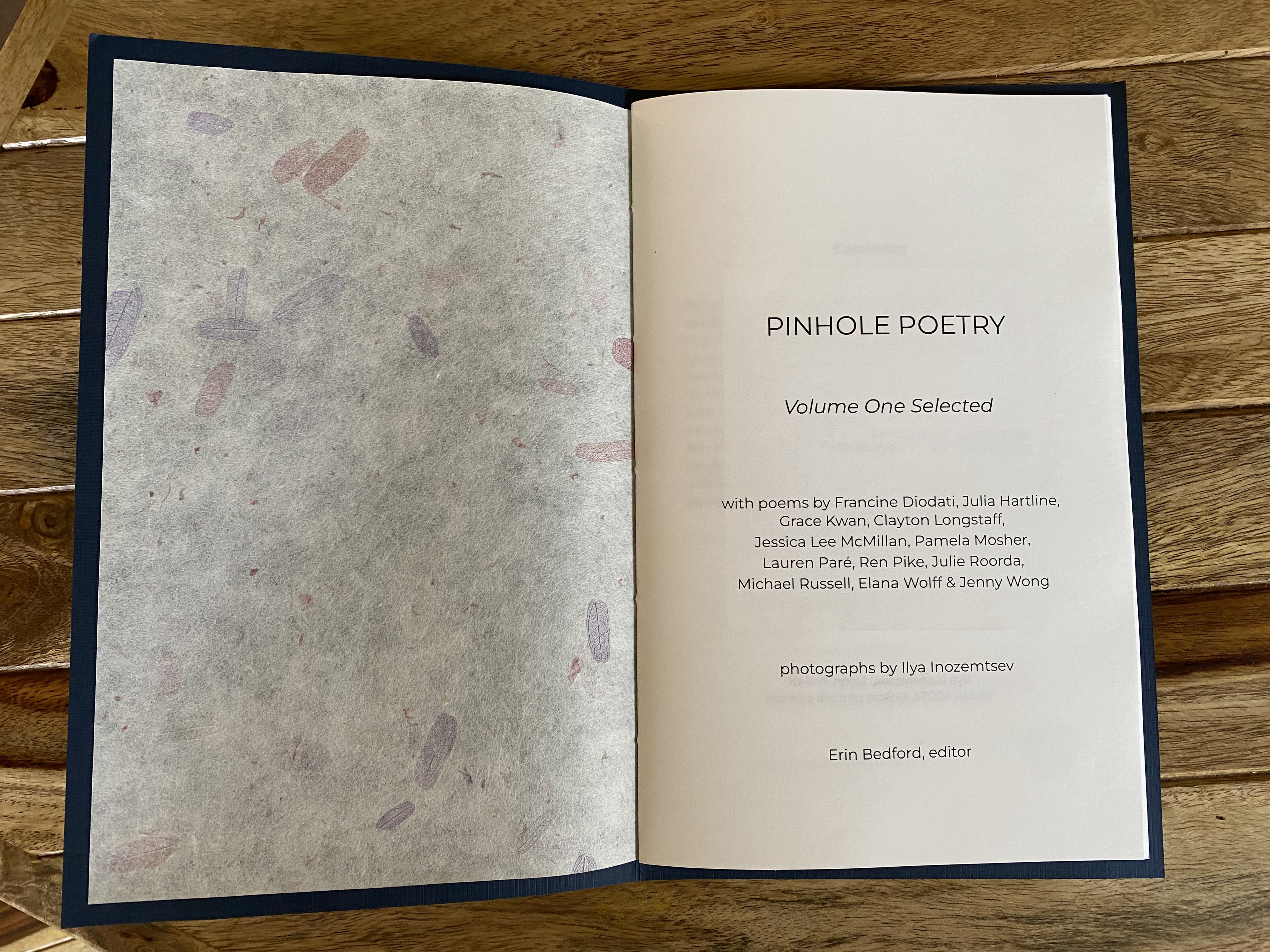
I try to extend this care to every Pinhole Poetry contributor and the art that they are generously sharing. I know I probably spend more time making pre-issue proofs, and thinking about the design of the website than a one-person editorial team normally does. I grant that it’s not necessarily efficient to spend time trying to find just the right background image for an interview quote that’s going up on social media. Pinhole Poetry just published its first print collection and the hours of time that went into finding fly leaf papers and textured paper for the interior, the hand folding and hole-punching and saddle-stitching, none of that will ever be earned back in sales. But Art is labour, and if I can’t pay Pinhole Poetry contributors any more than an honorarium at this stage, then their work deserves the maximum amount of my enthusiasm and attention.  I’ve read many threads on Twitter, from journals and presses justifying bad behaviour with the excuse of ‘I’m just one person,’ or ‘We do this in our spare time.’ It makes me angry. As publishers, we have a responsibility to the work, but also (and more so) toward the artist that creates that work. I hope Pinhole Poetry will always be a publisher that recognizes and reflects this attitude as we go forward with new issues and new projects (end semi-rant tangent).

The most recent new thing that I’m very excited about (and partly a product of an inspiring AWP talk about multi-modal publishing) is a feature that will appear in our next digital issue, something I think I’m going to call Dialogue. Using a pinhole photograph as a prompt, I’m asking for submissions of poetry in conversation with the image. In future issues, I’d like to switch it up and have a work of poetry act as prompt for pinhole photographs. It’s a way to have some play between the two art forms featured in the journal and, selfishly, I’m just interested to read the poems that come about.

I’m also gearing up to publish two printed chapbooks, beginning with a submission call in September. I really enjoyed the manual work of making the Volume One Selected chapbook, and think that it turned out beautifully. On behalf of the poets featured in Volume One Selected, I organized a virtual launch and set up a web shop, so in a practical way, I feel ready for the special responsibility of ushering in collections by individual poets.

And I’m always adding to Pinhole Poetry’s page of resources for poets. I’m interested in developing a community for poetry feedback and mentorship and I’ve been thinking about low-cost/no-cost ways to provide workshops and webinars that are useful and accessible to emerging poets. As a non-mfa poet, I’ve been on the search for learning material since I started writing poetry and I would love to be able to share what I’ve found and help others find what it is they need to keep writing, improving, revising, submitting, etc.

I expect the coming months will be very busy, but it’s work that I look forward to doing. Even after six issues and a print chapbook, an educational trip to AWP 2023, a branded t-shirt design (!), and a table at the Ottawa Small Press Book fair this past June, I still can’t quite believe I’m doing this. I feel so lucky that poets and photographers whose work I admire so much, trust me to put their work out in the world. When people ask me where the idea for Pinhole Poetry came from, I tell them that it’s been the only good idea that came to me in a dream. As my Notes App will attest, everything else my unconscious mind thought surely was an amazing idea or a mysterious phrase to build a poem around has, upon waking with a clear head, quickly revealed itself as total nonsense. To some, starting another online literary journal that makes no money and expanding it into a micro-press that publishes handmade chapbooks that also make no money probably seems like the same kind of sleepy foolishness. I think Pinhole Poetry has become something a bit better, a bit more—a little poetry/photography dreamscape in the real world.


Erin Bedford is a poet and novelist. After completing an Honours B.A with a Specialist in History at the University of Toronto, she attended the Humber School for Writers and was later mentored by poet Betsy Warland through Vancouver Manuscript Intensive. She is a member of The League of Canadian Poets and her short work has appeared in The Temz Review, Juniper, Map Literary, Train, GUEST, the lickety split & Catamaran Literary Reader. In April 2022, she founded Pinhole Poetry, a digital journal of poetry and pinhole photography.


most popular posts