Saturday, December 4, 2021

Jérôme Melançon : Experiments in Imagining Otherwise, by Lola Olufemi

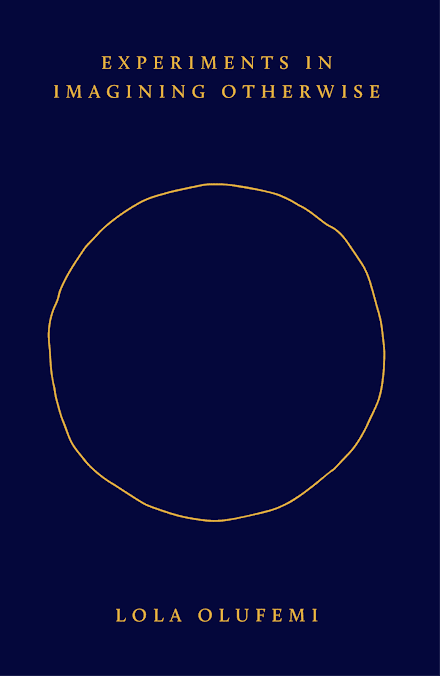
Experiments in Imagining Otherwise, Lola Olufemi
Hajar Press, 2021


Collapsing the past, present and future seems like a good idea.

Or maybe mostly shifting them around now and then, destroying circularity and linearity. A shell game, where each of the shells is full of something still indeterminate, past, to come, graspable all at once.

It’s a matter of decision, of embrace, of inhabiting. Of leaving blank spaces and filling others; of knowing that others need our blank spaces. Pulling on a thread, a rope, not to bring something closer to ourselves and take it away from others, but to pull ourselves closer to where we want to be, to those with whom we want to be.

So temporality is collapsed, shifting – well, no, because that’s giving temporality too much agency. This is simply something it can do as part of our experience, even as it envelops us. So: Lola Olufemi collapses and shifts temporality around. She brings the horizon closer, pushes the limits further, is quite concerned with the spaces we choose to inhabit and those we choose to leave.

In Experiments in Imagining Otherwise Olufemi sends no straightforward message, builds no thesis. This book is a manifestation, not a manifesto, not a work of theory, not a collection of short stories, not a book of poetry. Genreless, genreful, even as that brings it into the general surroundings of poetry, and taking from each of these forms, each moment of the book is something of all of the above. Full of forms, woven with so many materials, always concerned with grasp and touch, but not definite, not leaden – solid yet in flux. There is so much energy, the book is alive and alive differently through each of its moments.

This play on erasure, on what has to be erased, annihilated, destroyed, brought back without its meaning because it cannot disappear, because it is constitutive, because the future and the past hold one another. What has to leave place for new thoughts, new relationships, new lives. Men, capital, the police, the state, the factory, the expectations, possession: it’s one of those lovely books. Determinations, with pages that seem like forms to create manifestoes and works of revolutionary political theory because of redacted words, letting us see how little meaning come from specific choices, bounded concepts and ideas, and even from our settings. And the self – pages with blanks meant for readers to inscribe themselves. A fulfilling lack of continuity between moments, pages, but a constant striving.

To let the book speak for itself: 

“If we take imaginative potential seriously, we can properly articulate a politics committed to the expulsion of misery, a politics that is not ‘politics’, a schema that refuses persuasion, compromise, sacrifice, the trap of practicality.” (34)

“I want to fall into the gaps and then tear the gaps, smudge them, stretch them, rip them into tiny pieces and submerge my body in the material scheduled to be discarded, so that History will never find me.” (38)

“they are building a linguistic structure that defines the realm of the possible, that implicitly tells us to want less, to expect that total reconfiguration is out of the question.” (43)

“When we think about what we want, we also have to think about how we will deal with the multiple threats to our lives.” (84)

“The scope of our concern must extend beyond ‘I’–the individual person who we imagine exists in isolation–toward that ‘other’ who we imagine is separate from us.” (88-89)

“We need some ways of thinking poetically about grief & violent repetition and some ways of thinking practically about our next strategic move. both require a certain kind of belief.” (110)

“Some call that an escape from the misery of the day,
‘utopia’
becomes retreat, or another map for the future

but I want the full story suspended in impossibility
dripping with conjured things [...]

only a pattern of intensities that responds to the skin on
our fingertips.” (124)
 

Lola Olufemi gives us a tool, an incantation, a weapon, a pillow – an unbounded piece of affective technology (7). The beauty of it, the act of creation maintained in its non-state of uncertainty, as a call, as a desire, as a pull, as a moving into – an inflation of the material (8). A record of traces, an abandon to the multiplicity within any one phenomenon. (32) A theorizing from experiences, emotions, and strivings, and a piercing through of theory through fiction and appeals to participation. A book without walls, let alone a fourth wall to bring down. A packet of seeds for growing utopias.

When I say “she” I might be unfair: I could say “they” because there are many subjectivities within the book, many lives that are threatened, especially black lives, women’s lives, queer lives. The voice of the author shifts enough to let us feel that she adheres to utterances for the moment they are uttered, as long as they have the effect they need to have, the effect that made them worth putting on paper. Characters and unspecified others, leaving readers free to fill in these blanks as well. Some are simply nameless, their name taken away by the state along with their lives, their hopes. In this book as in so many others their lives find a value of which they had been robbed.

So many solidarities that even solidarities go unnamed - they are simply ready to be witnessed. As with much of the rest of the book: we can see, feel, almost touch connections, we readers have little choice but to set our own relations against those of the book. Beyond Britain, beyond Nigeria - or rather maybe superimposed, the pages like tracing paper to make compositions through superposition. Not just any relation, and not only solidarity, but love.

Love in that it can’t be lived outside of the market, of the prison, of the means of production, of the state, of their dispossession. Love in that it could be lived through different efforts, through refusals, through a recovery, through choosing to give in to others rather than to those forces. “Look, I think love is a matter of positioning.” (69)

A commitment to what communism or something like it or anarchism or something like it or collectivism or just togetherness can be today. To what kind of organizing and coming together full of the past can already be a future.

This book is a living gift with which to make gifts of life.
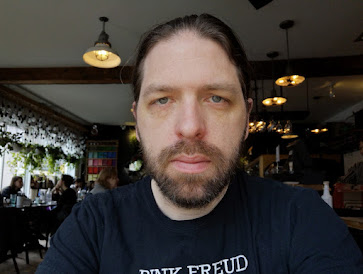


Jérôme Melançon writes and teaches and writes and lives in oskana kâ-asastêki / Regina, SK. His most recent poetry collection is En d’sous d’la langue (Prise de parole, 2021). He is also the author of a bilingual chapbook with above/ground press, Coup (2020), and of two books of poetry with Éditions des Plaines, De perdre tes pas (2011) and Quelques pas quelque part (2016), as well as one book of philosophy, La politique dans l’adversité (Metispresses, 2018) and a bunch of different attempts at figuring out human coexistence in journals and books nobody reads. That includes a few articles on one of his teachers, Miguel Abensour, and his forays into thinking otherwise and maintaining the utopian and revolutionary imagination sharp and ready. He’s on Twitter and Instagram at @lethejerome and sometimes there’s poetry happening on the latter.

Robert Hogg : Reading A Wolf Lake Chorus and The Ogre

Reading A Wolf Lake Chorus and The Ogre
A Suite in 8 Parts

for Phil Hall


1. 

I didn’t really
read A Wolf Lake Chorus
to the mechanics
 

at Hallville Garage
although they did
switch my summer
 

tires for winter
treads they didn’t
complain
 

There are no
wolves in that poem
only birds
 

and too many
ands
which
fails to explain
 

why I didn’t
sit and wait
like ordinary
 

folk my hands
tucked away
became
 

instead
engrossed in
reading A Wolf
 

Lake Chorus
to myself
then writing
 

this poem
to Phil Hall
or also to
 

myself
unhinged a poem
unwritten
 

can do that
drive you
mad
 

mad him mad
her an And an And
the birds
 

were making
small talk
and what I heard
 

I saw
playing a saw
until at last
 

Mad her
An and
broke free
 

RLH: Hallville ON: 2021-11-22 11:10 AM


2.

Blame it on
Trainwreck
covers I
 

meant to bring
The Ogre
along to read
 

but when I
got there I had
A Quiet Affair
 

they both looked
alike in
the gloom
 

RLH: Hallville ON: 2021-11-22


3. 

Maybe it's
just as
well
 

I didn't
bring
the ogre
 

to the
Hallville
Garage
 

bad enough
I thought it
was in my bag


4.

For you
the poem is
a catch-all drawer
 

ogres
elusive
wolves
 

for me
more a drawer
of catches
 

RLH: Mtn: 2021-11-23


5.

I’m not sure what
you’re doing in
The Ogre
 

unless you’re
shooting ahead
just
 

when language
wants to
hold you back
 

it’s not that you
don’t know
where
 

you’re going
it’s just
you’ve no
 

idea how
you’ll get there
each word
 

fluttering
a testament
to desire
 

RLH: Mtn: 2021-11-23 8:03


6. 

What I do
know is

you take
chances

I’d never
take

leap
from one

thought
to another

like a frog
on fire

2021-11-23 7:38 PM


7.

And when you
miss

the lily
pad

you swim
to the next

hop on
pretend

it was
intended

nothing
lost

no need to
explain

no
defense

2021-11-23 8:47 PM


8.

I get it now
language

the ogre
original

sin
set

everything
in order

paced it all
out in long

lines
and short

said
this is the way

it should
sound

beauty
demands

beginning
to end but

hearing
anew

breaks
the completed

word
sounds out

a new
cacophony

hidden song
unhinges

expectation
rhetoric’s

familiar
no more

assiduous
rise and fall

silence now
overtopping

sound wind
now crashing

sea
harmony

getting a
rewrite

ogre
free

2021-11-23; 2021-11-23 9:06 PM; 2021-11-23 9:16 PM; 

2021-11-23 10:42 PM


Robert Hogg was born in Edmonton, Alberta, grew up in the Cariboo and Fraser Valley in British Columbia, and attended UBC during the early Sixties where he was associated with the Vancouver TISH poets, co-edited MOTION - a prose newsletter, and graduated with a BA in English and Creative Writing. In 1964 he hitchhiked east to Toronto, then visited Buffalo NY where Charles Olson was teaching. After spending a few months in NYC, Bob entered the graduate program at the State University of NY at Buffalo, completed a PhD on Olson under Robert Creeley, and took a job teaching American and Canadian Poetry at Carleton University in Ottawa for the next 38 years. His books include: The Connexions, Berkeley: Oyez, 1966; Standing Back, Toronto: Coach House, 1972; Of Light, Toronto: Coach House, 1978; Heat Lightning, Windsor: Black Moss, 1986; There Is No Falling, Toronto: ECW,1993; and as editor, An English Canadian Poetics, The Confederation Poets – Vol. 1, Vancouver: Talonbooks, 2009. He recently published several chapbooks: from LAMENTATIONS, Ottawa: above/ground, 2016; two Cariboo poems, Ranch Days – The McIntosh from hawk/weed press in Kemptville, ON; Ranch Days—for Ed Dorn from battleaxe press (Ottawa 2019); A Quiet Affair – Vancouver ’63 (Trainwreck, May 2021); and in August 2021 a chapbook titled From Each Forthcoming (above/ground). In December 2021, a chapbook will be released from Hogwallow Press, called The Red Menace, and another from Apt 9 Press in Ottawa, called Apothegms. In April 2019 Hogg edited a Canadian Poetry issue of The Café Review in Portland, ME. His poems have appeared in over seventy periodicals, most recently: Pamenar Online; Empty Mirror; The Café Review; Dispatches; Arc; Some; BlazeVox Online Journal, The Typescript, Caesura, Ottawater 16, Sulfur Surrealist Jungle, Touch the Donkey and recent issues of Periodicities, Bandoneon, and Taint Taint Taint. In early July 2021 a Spoken Web podcast was presented by the UBC Kelowna Amp Lab featuring Robert Hogg’s life and career; it can be heard here:

https://spokenweb.ca/podcast/episodes/robert-hogg-the-widening-circle-of-return/?fbclid=IwAR33NVedL97y38qeWXrdsfgudBITBoPghg. His ideas on writing have recently been collected as five responses to questions from Thomas Whyte found here: http://poetryminiinterviews.blogspot.com/search/label/Robert%20Hogg.

Books currently in the works for publication include: Lamentations; The Cariboo Poems; Postcards, from America; Amber Alert; Not to Call It Chaos – The Vancouver Poems; Oh Yeah—More Poems. In progress are The Offending Temple, and Ill Parodies – O, a selection of satires on various Shibboleths and current affairs. Now retired, Hogg continues to write at his organic farm in Mountain thirty-five miles south of Ottawa.


most popular posts