Showing posts sorted by relevance for query charlie. Sort by date Show all posts

Monday, November 1, 2021

Kim Fahner : Why I Was Late, by Charlie Petch

Why I Was Late, Charlie Petch
Brick Books, 2021
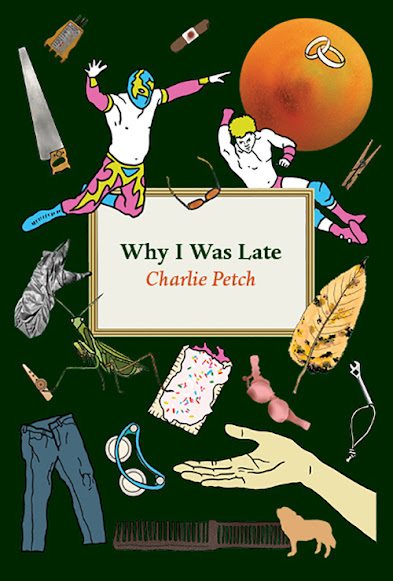


As a reader, you’ll know that Charlie Petch’s Why I Was Late is going to be quirky and fresh as soon as you read the first poem. In “Dear C-3PO,” Petch imagines that C-3PO and R2-D2 were lovers. Later in the collection, there is the very clever poem, “Wookie Love,” a hysterically imagined supposition of what it would be like to be lovers with Chewbacca. Petch writes: “The love cries of my partners have never equalled/the parallel universe of what comes out of your/small-toothed mouth” and “I want to twist and grind you until we become/dreadlocked./dreadlocked//(I'd take them out later though   because I'm white).” Anyone who grew up in the late 1970s or early 1980s, who was around for the first big Star Wars wave of pop culture hysteria—and so who also might have collected those action figures of Han Solo and Princess Leia—will smile nostalgically as they read these pieces.

There are, too, the poems that speak to bigger notions of identity and pop culture influences, and how fame can distort reality. In “The Ballad of Owen Hart,” the poet writes of a famous Canadian wrestling star who “died on live TV” and of Hart’s “fallen beauty” in the ring. They question the cost of fame, the need to fashion a persona that requires “costumes/that make you feel foolish.” Then, a reflection on Mike Tyson’s career is found in “My First Lisping Hero.” Petch writes of the famous American boxer’s troubled life—struggling to try and capture that life’s truly mercurial essence—ending the poem with lines that sit powerfully in the reader’s mind: “Some humans are capable of so much/when we give them a chance/to get up off the mat.” There is always hope, the poet suggests, when we do not box people up and make them colour inside the lines. Petch’s poems about Hart and Tyson ask the reader to think about what other parts of personality that so often are hidden behind the mask of celebrity. There are surfaces and there are depths, and Petch asks us to think about the depths—to go beyond the superficial aspects of what we initially see in pop culture to find deeper truths.

The theme of identity—and of speaking personal truths—is consistently present in Why I Was Late. Petch is a transmasculine “poet, playwright, librettist, musician, lighting designer, and host” who has their roots in spoken word poetry. In several poems, Petch speaks to the pain and trauma that occurs when gender is wrongly perceived as being restrictive and not as something that can be fluid and intuitive. In “Schoolyard Theatre,” the speaker recalls a party where “I was a guy at a party/fake smoke and drink in hand/my body relaxed/into boy.” In “Dropping Doves,” the poet speaks of Matthew Shepard’s murder, of “brutal men,” and of the hope of  “better models of masculinity.”

Later in the collection, in “Why Did the Trans Kid Cross the Road?”, Petch writes about the Ontario Conservative government’s decision, in 2019, to debate the existence of trans and non-binary people, and how the government “gave out a hotline number to report teachers talking about gender identity or respecting pronouns.” Petch writes, poignantly and powerfully, of how speaking a truth can result in severe mental anguish for young people who are grappling with their gender identity. The figure of a crossing guard—someone committed to protecting children—might be different under this new regime. That guard might be someone who “grips the pronouns” as “blood spills/between his fingers,” might turn into someone who “doesn’t stop cars.” Petch reminds us that we need to speak up in favour of diversity and acceptance, to speak up for the safety of young people.

Charlie Petch’s Why I Was Late is so very richly textured. There is a clear voice here that calls the reader to note social injustices, to speak up and speak truth for the good of self and others as well, but there is also a beautifully tender and personal voice here, one that speaks of love and of love lost, of humanity’s inhumanity but also of its big, beautiful heart, and a voice that takes careful note of the sheer beauty of life itself. In “Our Love Is Groundless,” Petch writes: “When you tell me you love me/I orbit the earth.”  In “Muscle Memory,” four short lines that hum with power sing on the page: “Don’t tell me/I’m strong/ask me how/I got there.” There are so many other beautiful things to notice in this debut book of poems, but these are the ones that sang out to me. If you haven’t read Why I Was Late yet, I’d suggest spending time with Petch and their poems.


Kim Fahner lives and writes in Sudbury, Ontario. She was poet laureate in Sudbury from 2016-18, and was the first woman appointed to the role. Kim's latest book of poems is These Wings (Pedlar Press, 2019). She's a member of the League of Canadian Poets, the Ontario representative of The Writers' Union of Canada (2020-22), and a supporting member of the Playwrights Guild of Canada. Kim can be reached via her author website at www.kimfahner.com

Sunday, April 4, 2021

Kim Fahner : A Different Wolf, by Deborah-Anne Tunney

A Different Wolf, Deborah-Anne Tunney
McGill-Queen’s University Press, 2020


You’ll know this is a different sort of poetry collection when you see the cover for Deborah-Anne Tunney’s A Different Wolf. It’s an oyster colour, with a solitary eye peering out from a peep hole at the centre of it all. This suits the overarching tone of the book, given that the poems explore the cinematic worlds that were created by the famed 20th century British born filmmaker, Alfred Hitchcock. In places, the work feels voyeuristic, but perhaps that comes from my having read about how terribly Hitchcock treated his female actors and employees. I bring that pop culture knowledge and reference to my reading of Tunney’s book of poems.

For some reason, I remember watching a few Hitchcock films while I was in my teens. I specifically recall Rear Window, Psycho, The Birds, and Dial M for Murder, although I’m not even sure why these are the ones I recall more vividly than any others he made. I remember thinking they looked slick on the television screen, and that the women and men always seemed one-dimensional, perfectly dressed and turned out. They seemed so stylized, and epitomized what I thought and imagined Hollywood was about in the glory days of cinema. Those films of his, though, were illusions—all polished and seductive on the screen. Still, I was always left thinking: what’s buried  underneath it all? What’s hidden? Where’s the substance? Why is it so superficial?

Tunney gets at this notion of appearance versus reality in a number of her pieces, including the Vertigo-inspired poem, “The Redwoods Bear Witness,” with the lines: “The crash of waves held in his/mind as he bends her head/back, locks her in a kiss/love, like light, illuminates her fake face.” Then, in “Charlie and Charlie,” the poet writes: “This was the moment when she/tore the front door off his façade and saw the/tailored swine lurking within.” No one is who they seem to be in any Hitchcock film. They are all superficial and slick, hiding underneath with satchels of secrets yet to be discovered.

You read the poems almost hesitantly, a bit nervous, and feeling the suspense that Hitchcock created, but also unsettled by the way in which women were portrayed and presented in so many of his films. He was that omnipresent eye—as director and filmmaker—and his presence is felt throughout A Different Wolf.  The epigraph—and the title—for the collection finds its origin in something Hitchcock himself wrote: “Nothing has changed since Little Red Riding Hood faced the big bad wolf. What frightens us today is exactly the same sort of thing that frightened us yesterday. It’s just a different wolf.” Hitchcock is a creepy cinematic genius of sorts, and maybe that is why we find him so fascinating as a strange Hollywood icon—perhaps because his work was able to reflect some of the unsettling social and cultural undercurrents of his time.   

The part of the collection that really sings, I think, is titled “Time and Death.” These are the poems where Tunney explores her own personal connections to Hitchcock’s films. In “Watching Vertigo,” the poet writes: “I understand that evening out/the rear view window of the DeSoto/the bridge distant over his shoulder.” Her skill with imagery and metaphor is evident further in the poem when she writes: “I know what it means: the fabric of his longing/the unfurling of waves pulling him out/like the moon pulls him free of his wrong yearnings/past the crags, into an eternity of blue and loss.”  Then, in “Drive-in, 1969,” Tunney reflects on the draw of Hitchcock’s films. They offered an escape from the realities of life, so that “we did not notice our fate/playing out in that living room with its piano, its portrait/of dead parents, the fireplace…” In “The View from Point Reyes,” she writes: “I’ve been there, by that bridge, by the lighthouse on Point Reyes/I’ve seen days like that, starkly bright, when the hills are burnt/and faded from the sun.” Tunney can, as a poet, root her memories in images that are beautifully cinematic in scope.

Each poem in A Different Wolf is inspired by a film, but you needn’t worry that you won’t understand the poems if you haven’t seen the movies. If you haven’t seen them, it feels—from a reader’s point of view—that you can now almost enter into them in a sort of strangely voyeuristic and interactive way. The section titled “Woman in the Male Gaze” also speaks to the time in which Hitchcock lived and flourished, and reminds readers of the social mores by which many men and women were strangely governed at the time. What’s seductive about this collection, though, is the way the poems feel like tiny excerpts of films you may or may not have seen once in your youth. A Different Wolf is both poetic and cinematic; it walks between worlds, and it invites readers to tread carefully—to find their balance so they can always come back to the present if the internal world of a Hitchcock film becomes too dark or overwhelming. For those who love poetry and film, this book of poems might be right up your film noir alley.


Kim Fahner lives and writes in Sudbury, Ontario. She was poet laureate in Sudbury from 2016-18, and was the first woman appointed to the role. Kim's latest book of poems is These Wings (Pedlar Press, 2019). She's a member of the League of Canadian Poets, the Ontario representative of The Writers' Union of Canada (2020-22), and a supporting member of the Playwrights Guild of Canada. Kim can be reached via her author website at www.kimfahner.com

Monday, February 1, 2021

Stan Rogal : J. Michael Yates: A Tribute


Who was J. Michael Yates? One may very well ask. Ultimately, he was April 10, 1938-April 15, 2019. Born in Fulton, Missouri, died in Vancouver, B.C, age 81, having succumbed to “a variety of ailments,” the exact nature of which went undisclosed in the Alan Twigg obituary, which somehow seems fitting, given — so-on-&-so-forth — his Un Canadian Errant persona, let’s say, politely: logger, powder monkey, motorcycle racer, commercial photographer, advertising exec, outdoorsman, avid fisherman. Beyond this, he was an award-winning writer of poetry, fiction, radio/TV/stage plays (performed in several different countries in several different languages), translations and philosophical essays. He was a mover, shaker and all-around firebrand within the (admittedly cloistered) Canadian literary landscape, instrumental in starting up many magazines, including Contemporary Literature in Translation at UBC, as well as the alternative presses Sono Nis and Cacanadadada (now known as Ronsdale Press) both since gone mainstream/MOR — a condition which has plagued several other formerly alternative literary Canadian presses over the decades, but I digress. In fact, Twigg said of Michael: “He was one of the most influential literary figures in British Columbia during the 1970’s when he was regarded by some as one of Canada’s most determinedly experimental writers.”
         
Who knew, and what happened?
         
What happened was that he was also somewhat of an outlaw hell-raiser, highly opinionated, and a general thorn in the side of anything or anyone that represented an attitude of habitual closed-minded bureaucracy. He also had a wicked (and erudite) sense of humour. An often bad combination in the workaday world. He apparently was fired as a radio broadcaster when he closed the weather report with: ‘It’s hot, Charlie!’ The phrase ‘a hot Charlie’ was popularly known stateside as used by GIs in the Vietnam jungle to describe taking a big stinking shit. The powers that be were not amused. It was likely not his first (or only) transgression on or off the air.     

         
I came into contact with Michael in Vancouver sometime in the mid-seventies. He was teaching a night school class in creative writing at a local high school. I had no idea who he was, other than a teacher. He was boyishly charming, energetic and cheerful, with a mischievous grin. As he handed out a thick stack of what and who every wannabe writer should read, he lit up a thin cigar and mentioned off-handedly that it might also be a good idea to read something of his, if only to gain some insight into him as a writer. The classes were fun and informative; provocative, even. I read his books. His work was definitely outside the usual fare provided by (at least my) high school education system, and a welcome change. Even when his poems were set in nature, they defied the usual ‘blissful and bucolic’ and were instead imbued with an urban perspective and sensibility: gritty, intelligent, philosophical, metaphorical. “I persist in a little fabric between me and the world,” he wrote. His fiction included much bending and blending of genres, something I wasn’t very familiar with at the time.  
         
On the second to last week, as class began, he was summoned outside by the janitor, who told him that he had discovered crushed butts on the floor several times, had deduced that it was him that was responsible, and that there was absolutely no smoking allowed in the school, or on school property. Michael took offense and replied that this was a class for adults and that adults were free to make their own decisions. The janitor wouldn’t back down and continued to cite policy, which further infuriated Michael, who finally grabbed his gear and roared out of the building. That was that, as they say. Class over, course over. Turned out he’d already burned his bridges when it came to teaching at the University level, and it was only through a friend that he got this gig. I gather the friend was unable to help further.

         
My last meeting with Michael was at his house in Surrey, to pick up some material of mine he’d been going over to comment on before the janitor debacle. The first thing I noticed were stacks and stacks of Pepsi cases in the kitchen, filled with bottles, either empty or full, depending. ‘Don’t mind those,’ he said. ‘I gave up the booze, so.’ He motioned with a hand. That was it, as far as offering an explanation.
         
I heard later through a writer-friend of mine that her husband managed to get Michael a job as a prison security guard in Burnaby, where he himself worked. Rather ironic, I thought, given his penchant for bucking authority. Apparently, he managed to last 17 years and even wrote a book about his experience, so maybe it wasn’t so ironic after all. Maybe somewhere deep down inside he needed something with strict rules and regulations to calm him, to satisfy him, or maybe he just liked to hang out with the real bad-ass outlaw types, as opposed to literary outlaws, I don’t know.

         
The years slipped past and recently I saw his name in a used anthology titled Ground Works: Avant-Garde For Thee, edited by Christian Bök and Margaret Atwood. I recalled those few times I’d met him. Recalled his sense of humour, his energy, his love of literature, and his generosity to share his considerable knowledge and offer straight honest feedback to folks like me, eager, but totally naïve when it came to the art and craft of writing. I decided to Google him to see what he was up to. That’s when I discovered he’d died. Nothing in the press that I’d seen. Nothing in the professional newsletters that I received. Nothing through the various social media or grapevines, which I don’t belong to, but seem to reach me as a rule anyway.
         
I’ve heard that if even one person complains about a book on a school library shelf in Canada, that book is immediately removed, quietly, discreetly, not censored, no, simply undefended (why raise a fuss?), ‘out of sight, out of mind.’ I think this is what happened to Michael. Having kicked against the pricks, the pricks (as is so often the case), eventually won out. He was routinely removed from the shelf, to remain unstudied, unheralded, unremembered.

         
Too bad, so sad.
         
Well, nothing else to do except read the piece in the anthology, a fragment (terrific) from a larger piece titled, And Two Per Cent Zero. Nothing else to do except write my own piece, an erasure, a fragment lifted from a fragment (fittingly), as a tribute and a reminder of someone who inspired and assisted me in my own growth as a writer, for better or worse.

         
Cheers, Michael!                


erasure: and two percent zero
        
for J. Michael Yates

                               Never learn to swim.
                              
It only prolongs the drowning. 


no question whether I should protest this damming of the water
drawn by no moon whatsoever, a tide is rising
the diminutive light collides with the corner of the coffee table

the roof of an old silvered cabin is floating
through the window a dam under construction passes

the snake w/something to say says disregard the burning bird
I (with my bald head) am about to refuse the dare to cross the young ice

there’s knowledge in it, the way ice stops things, sublime, just like that
the heavy ravens rise slowly & the wind twists like a hooked fish

the railroad’s gone viscous with its river of cargo & a bull moose in rut
rain brings down the dust, the mercuric pulver, the radioactive residue

train passengers wear fish-bowls of water over their heads
so much of my hair & fingernails are already in the sea

water-birds dive for small fish, water-snakes prey upon the hungry birds
you call to me through the fog in my fingertips

the grey residue seeps into the smallest crack, thickens upon the lungs
(the weather in my cells will have me one way or another)

let’s lie down & make angels: fish, birds & reptiles in particular
what does the moon care if water derives from snow or vice versa?

it’s time to be off anyway; the fly-zipper on my trousers is gefritz
so much ash & dust from the railroad has entered the water

a last bird perches on the recalcitrant train stack; the rest is submerged
I’m going out to die in the snow; my lungs will drown me one flake at a time

slow suicide by ice-fog, far from the railroad that hoots ash over the drifts
only the water-snakes are with us & they’re having a hard time

look! the women all have birds beneath their skirts!
at the terminus of the long metabolic ceremony
                    
only the trousers of my youth remember my form 


Stan Rogal is currently hunkered down in the pandemic-ravaged city of Toronto where he continues to follow Sam Beckett's edict: "I can't go on. I'll go on." He has published widely and is the author of 26 books: 7 novels, 7 story, 12 poetry and several chapbooks. He is an amateur sleuth and thespian, as well as a master in hand-to-hand combat. He also makes a mean martini.


Monday, June 1, 2026

Emily Shafer : I found looking: from Poetry on the Porch


On June 1, 2025, after receiving an unexpected invitation to Jennifer Firestone’s Poetry on the Porch reading, I made the trek out to Midwood from Manhattan with my partner Jessica—whom I often drag to readings, despite her general disinterest toward poetry that’s not mine—to hear Eileen Myles and Charles Bernstein read. We arrived early, sat on chairs positioned in the grass before a beautiful blue house. Strangers walked behind us on the sidewalk, looking over, curious about what the event was.

I settled in, observing the crowd gathering. I spotted Eileen and a family friend and now poet friend of mine, Michael Ruby, getting food at the hors d'oeuvre table. Too shy to go up to them, even though I’d spoken with them many times before, I took in the surroundings, a tree-lined street with massive houses (in New York City!)—ours, blue with white trim, a wraparound porch supported by gorgeous white columns atop a wide white and brown staircase. On the porch, a few seats, some books for sale, a bench swing, a lone mic centered above the stairs, and tons of people Id never seen before.

I saw one of my professors from Brooklyn College, Mónica de la Torre, arrive. —What are you doing here? —What are you doing here? —Eileen invited me, I ran into them at the Poetry Project a couple of weeks ago. Mónica proceeded to run around, say hi to friends and colleagues and grab food. After a few minutes, Jennifer took the stage, asking everyone to sit and prepare for the reading. At that moment I saw Michael again, said hi, that we would talk after. Quickly, he showed me his new book, Sounds of Summer in the Country. In it, a poem titled “A Cricket”—a page full of “ti”s and asterisks indicating cricket noises and pauses. That was the whole poem. We laughed. I thought it was genius. I didn’t know you could do that.

Eileen read first, reading a long poem for the recently passed Alice Notley, shedding pages from their stack onto the floor as they read. The audience was in awe. While Eileen read, an unknown (to me) toddler kept approaching them with snacks that he had taken from the hors d'oeuvre table that they were definitely not going to eat—they probably fell on the floor or were in his mouth before he handed them over. The audience laughed.

Before the reading, Eileen mentioned that a hat was going around the audience for babysitting money for their new dog, Charlie, that they wouldnt have been able to come if they hadnt got a sitter, that it cost $40. I had two dollars in my backpack that I found on the ground a few days earlier. I put them in the hat.

After Eileen, Lila Zemborain read in Spanish, with her son Lorenzo Bueno translating her work into English. Charles read third, commanding the stage as usual. I wondered what it would be like to be invited to read among poets such as Eileen, Charles, Lila, surrounded by an audience of poets who are close friends.

Following, Jennifer mentioned that there was a film and artwork by artist Astrid Dick inside. After chatting outside for a few minutes, everyone made their way inside to a long table in the entryway holding Astrid’s zines and paintings. We listened to her tell us about them, and eventually make her way over to the projector in front of the bay window in the living room, where we watched her experimental piece including sound and text. She talked about it after, before dismissing the audience. On my way out, I took a zine from the table. I thought it was genius. I hope to make zines one day. I hope to make art films one day.

Once outside, I ran back into Mónica and Michael. Mónica introduced me to Lila and Michael introduced me to his friend, the Executive Director of the New Orleans Poetry Festival, Sean Munro. We chatted for a bit: —How is your program? —What are you doing in New York? —Will you come to the New Orleans Poetry Festival? —Here have my card. —Were best friends, Sean is staying with me for a week. I felt a strong connection to the New York City poetry scene, then. I felt as if I were a part of it.

Throughout the day, I took notes in the Notes app on my phone. I wrote the poem I found looking from my notes shortly after. It didnt take long and hasn’t been edited much since. In the poem, you can find Mónica (her), Sean, Michael (you), Charlie the dog, the unknown child giving Eileen snacks, Astrids (art maga)zine, as well as my longing to be a successful poet like Sean, Mónica, Michael, Eileen, Lila, Charles. I was an observer during that event, but also, by being there, was becoming part of something.


Emily Shafer is an incoming MFA candidate in Image Text at Cornell University, holds an MFA in Creative Writing, Poetry from Brooklyn College, and teaches first-year writing at CUNY. She is the author of it’s too early for poetry (Proper Tales Press), I found looking (above/ground press), and publications in poets.org, The Brooklyn Review, periodicities, and more. Born and raised in Rochester, N.Y., she lives and works in New York City. @emilyshaferwrites / www.emilyshaferwrites.com

most popular posts