Saturday, November 6, 2021

rob mclennan : Amanda Paradise: Resurrect Extinct Vibrations, CAConrad

Amanda Paradise: Resurrect Extinct Vibrations, CAConrad
Wave Books, 2021
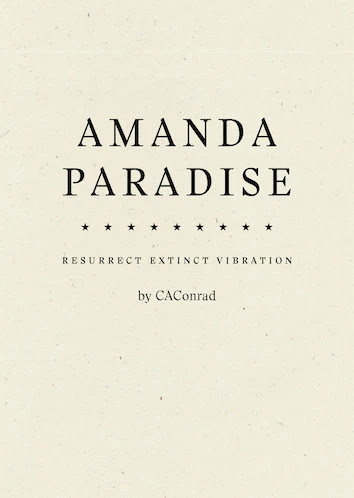


I’ve not always known how to articulate my thoughts on the work of American poet CAConrad, who feels consistently working on a level far above what I am able to possibly conceive, and through multiple titles going back at least fifteen years, including Deviant Propulsion (Soft Skull Press, 2006), (Soma)tic Midge (FAUX Press, 2008), The Book of Frank (Chax Press, 2009), The City Real & Imagined (with Frank Sherlock; Factory School Press, 2010), A Beautiful Marsupial Afternoon: New (Soma)tics (Wave Books, 2012), Philip Seymour Hoffman (were you high when you said this?) (Worms Press, 2014), ECODEVIANCE: (Soma)tics for the Future Wilderness (Wave Books, 2014), While Standing in Line for Death (Wave Books, 2017) and JUPITER ALIGNMENT: (Soma)tic Poetry Rituals (Ignota Books, 2020), as well as a book of nonfiction essays, Advanced Elvis Course (Soft Skull Press, 2009). Their latest title is Amanda Paradise: Resurrect Extinct Vibration (Wave Books, 2021), a remarkable assemblage of lyric attention comprised of a suite of one hundred or so self-contained poem-shapes. The collection opens with more than two dozen single-page poems before launching into “72 CORONA TRANSMUTATIONS,” structured as a seventy-two poem-shape sequence, each of which are set at the bottom of each page, and closing the collection with the lyric essay, “RESURRECT EXCINT VIBRATION: A (Soma)tic Poetry Ritual.” As they write to open their nine-part afterword:

Amanda Paradise is the author of this book, and by CAConrad is its title. I did not mention this earlier because I did not want to interrupt your conversation with the poems. A (Soma)tic poetry ritual I did a few years previously to overcome my depression after my boyfriend Earth’s rape and murder led me to “Resurrect.” I was sitting on a forest floor in New Hampshire when I realized that this man I loved, who had changed his name to Earth, died from the very same wounds humans inflict on the planet: he was bound and gagged, beaten, tortured, raped, then covered in fossil fuels and set on fire. This connection brought a flood of grief. After my tears subsided, I lay flat on the fallen leaves, feeling my breath sync with the soil beneath me and with the wind, birds, insects—and as suddenly as I had burst into tears came a lavish shower of peace. It was extraordinary, instantly feeling these connections in my body. These sensations guided me to the “Resurrect.”

There is such a meditative and thoughtful quality to the poems in this collection, writing the world and around the world in a deeply personal eco-poetic that is fully aware that ours might be a culture and planet that is irrevocably broken. “I am so fucking sick of nations,” CAConrad writes, to open the poem “ONLY IN STACKING BOOKS CAN THE TREE FEEL ITS WEIGHT AGAIN,” “and the men who love them / the number of suicides / this afternoon hiding / in the bottom of a cup / I feel feral out here / found a man who likes me like that / found a man who lives the way I do / 7 years on the road anniversary soon / you only have to destroy [.]” The poems are unflinching, sad and occasionally angry; poems that would rather be celebrating joy, hope and love, but can’t turn away from inequalitites, citing American imperialism, homophobia, male aggression and micro-aggressions. “I have nothing but exclamation points / for this world some days,” they write, as part of “!! !,” “one for shock / one for disgust [.]” Or the poem “45 MINUTES TO RESCUE THE PHOTO ALBUM BEFORE THE GARBAGE TRUCK ARRIVES,” that includes: “tell the children when US poets pay / their taes homes of poets in the / Middle East burn to the ground [.]”

Amanda Paradise is a poem-suite that writes on death and history, old boyfriends and politics, the death of friends and lovers during the AIDS crisis, singing, ritual, vibrations, extinction, heartbeats, social distancing, reading Eileen Myles and gay rights. “everything matters because everything / hurts someone somewhere as it is mattering,” they write, as part of the poem “CAMISADO.” Or as one of the poems from the sequence “72 CORONA TRANSMUTATIONS” writes:

          neither the virus nor
         the tornado can
stop the other from racing across the country

there is a tree in Kansas
I hope to see again

In a 2019 interview for TANK Magazine, Josie Mitchell describes CAConrad’s “series of visceral, messy, erotic bodily practices called (soma)tic poetry rituals – activities designed to help people find their bodies, escape their routines and default modes, and instead live and write poetry in the ‘extreme present’ with ecological sensitivity and reverence for nature.” Ritual has long been important to CAConrad’s work, comparable to the attentions of Perth, Ontario poet Phil Hall; displayed in their works through the attentive gesture of a highly deliberate lyric. Even just to look through CAConrad’s book titles is to see the “(Soma)tic ritual” as a thread that runs through their work, offering up the ritual as a way to connect to the world and respond as part of that connection. As part of the interview itself, CAConrad responds:

I have been working on an extensive (soma)tic poetry ritual that I call Resurrect Extinct Vibration. One of the ingredients of this ritual is that I lie on the ground and flood my body with recordings of recently extinct animals. In my lifetime, our planet has lost 60% of its wild creatures. When a species leaves the earth it takes all of its sounds with it: heartbeat, breath, footfall, gallop, wing flutter, purring, singing, crying, laughing, chewing, all of it gone forever. Humans are changing the sonic landscape, and the loss of our organic, wild vibration is part of that change. Another, newer ingredient to this ritual is to spend time in the vast abandoned, bankrupted shopping malls and other megastructures across America. My Instagram account is devoted to photos of weeds breaking through cement. This world is worth fighting for! We are not going to be able to reverse things to bring back the many plants, insects, birds, fish, mammals and other creatures that have become extinct in our lifetime, but we most certainly can stop or slow the haemorrhaging of our planet’s vitality. But to get everyone seeing what change is possible, we have to get everyone being creative in our lives. Only creative minds can imagine and then build that possible future we will need to survive. My job is not just to create, but to show others their abilities. In workshops, I always start by saying, “If our creativity is an organ, we must begin thinking of it as a vital one.” I understand the paralysis that trauma and depression can bring to our lives, and I also know my rituals stand on the shoulders of centuries of poets who smashed open barriers of language and insisted on saner, caring systems of government. I think of Charlotte Delbo surviving Auschwitz and in her poems reminding us: “And finally it would be too stupid for so many to have died and for you to live and do nothing with your life.” Of Dennis Brutus dreaming his poem about Sharpeville in the cell next to Nelson Mandela’s, and of Janet Frame narrowly escaping a scheduled lobotomy in the mental institution because she won an award for her writing. Just imagine what they would have done to her mind and her writing if she had not won that award! There are so many poets to thank, where to begin?

There are elements of Amanda Paradise that seem to connect back to The Book of Frank (2009), the first CAConrad title to catch my notice, for their shared book-length attention to grief, ritual and impossible loss. And it is impossible to really showcase the gesture and shape of these poems without displaying them in full, composing a lyric formed into visual shapes, reminiscent to elements of Guillaume Apollinaire or bpNichol. Despite the strains of grief and loss thread through these poems, the shapes and gestures of Amanda Paradise display a high level of formal inventiveness, play and even joyfulness. Honestly, there is such a sense of joyous celebration and of acknowledging the small moments and gestures (again, similar to Phil Hall in that way) that CAConrad appears to refuse to let go, despite whatever else might occur. And in the end, perhaps this might be the very key to our ongoing emotional health, if not even our continued survival. As the opening poem of “72 CORONA TRANSMUTATIONS” reads:

for years after
 
  friends died of
 
   AIDS they still

 
    danced with me in my dreams
  
     did survivors of the bubonic plague

   
     dance with their dead
    
     who will dance

     
     with whom
      
    in a year

       
  let’s
        
keep

 
       safe
 
     dance

 
  together
IN PERSON


Born in Ottawa, Canada’s glorious capital city, rob mclennan currently lives in Ottawa, where he is home full-time with the two wee girls he shares with Christine McNair. The author of more than thirty trade books of poetry, fiction and non-fiction, his most recent poetry title, the book of smaller (University of Calgary Press, 2022), is now available for pre-order.


Rob Manery : Two poems


The Circle is Not Named
for Bob Hogg


The circle is not named
to be drawn in a triangle
 

even to the uttermost
for even the scientist

is lost in the terrible
midnight.
We were

glad to get the meat
and never fashed

for kitchen. Along the
furrow here,

the harvest fell
on the table

beneath each
busy hand,

the light ceases to be
mere words

that defy the thought
of anything essential

to any of them,
sinking into

the emptiness
of mere chance.

What's the point
of reading

if it makes you feel
uncomfortable?

The table was a large
one, room yet

for a distinction
between overweariness
 

falling into sleep. Who's
interfering with which?

At all times an other I, that
same other. Perhaps we've

come the wrong way. The original
number disturbs

nothing
but ants about this

hill carried on
by the unseen

language is always
a mosaic work, made up

of associated fragments,
not of separate

molecules. The man
recovered of the

bite, entertained only
with the air of

words from the box
to the basket.

He had placed
a flower in a vase

on his desk and
pretended that he

could not understand
my
German. The elbow

of a hedge jutted forth, wraps
and furs lay in heaps

on the chairs,
overcoat

on the table. When
he does
sit up 

and takes notice
he doesn't so much

as come with a thought,
knowing that you think

it's because of my
solitary manner of life,

putting me in mind
to have these

inexpressibles altered,
who dare, like him,

to think out loud.
Those who know

how the wheels turn
are always bored

at the top
of the furnace.

Who could answer
with fewer words?


No Bus In Sight
for Clint Burnham


An alarm clock
         
sounds in
the apartment

         
down the hall.
Outside an

         
empty U-Haul,
gracelessly

         
towed. If we sit
in this seat,

         
it does not betray
friendship, only

         
frailty. No bus
in sight. A moment,

         
slightly longer
elsewhere, signifies

         
now
only in a
local sense. Since

         
Christmas, we have
travelled one hundred

         
and fifty-two million
kilometres round

         
the sun, despite a
complete lack

         
of upward mobility;
a penny dropping,

         
exhausted by the
effort to remain

         
non-judgmental,
for lack of

         
a better conception,
for in Wayne Manor,

         
one must still
dress for dinner.

         
The trains are
running late. Do

         
you suppose it’s
customary, no, to accumulate

         
paregoric allegories
to assuage detained

         
travellers? The vegetal creeper
traverses the trellis while

         
we await your arrival.
What does it mean

         
to understand love, for instance?
She patiently explained the

         
procedure for drying
the seeds. We are at sea,

         
he suggested dryly. The engine
cut halfway up the

         
hill, a loose estimate
admittedly, and not

         
easily conceived like
transferrable skills.

         
A 20-minute ride
a year ago, but

         
an old man is
still left standing

         
in the light
rain. Now is the time

         
to plant the bulbs, before the
first frost. What is the

        
difference between
a concept and

         
an idea? A reference
that only persons

         
of a certain age
perceive as poetry.

         
Waiting in the rain
is not poetic. She shivered

         
as she sat on the
partially sheltered

         
bench, a table
of schedules lay

         
between them. Well,
it was him

         
who clothes
the kettle, but now

         
is itself cloaked. What
would it mean

         
to wait demurely?
It seems that I

         
have been of little
assistance in these

         
matters. You didn’t
notice, why would you,

         
certain gestures, a preference
to make haste

         
dismissed out of hand, out
of time. This is what

         
is remembered when we
listen to music. Was that

         
you? There were noises
they didn’t particularly

         
want to hear getting
through the thin

         
walls, everyone living
in the building

         
at once. At one
time the bus went

         
directly downtown, but
there are silences throughout

         
the night, a subtext
circumcising our living

         
situation. She gradually
sifted through the newspaper

         
notices, acclimatizing to
the cold rain. Put

         
the wood in th’ hole
from a sub-dialect indifferent

         
to the hours of listening
to another’s television, a

         
din not yet remote,
or a responsive relief,

         
not the repeated thud
of parietal lobe

         
rubbing against the idioms
of a certain school

         
conflicting with the
familiarity of neighbours.

         
A loin-cloth left behind
in the bus shelter, drops

         
of rain making riverlets
on the windows

         
of the train, obscuring
the view, but loving it

         
just the same. Anticipating
a particular gesture, parsed

         
peculiarly. At what
point do we admit

         
we’re mistaken? I thought
I saw the orange lights

         
of the bus, but perhaps
plastic caps cast

         
reflected light, wooden
slats surrounding the

         
concrete slab on which
the structure rested, for

         
in that instance I was
convinced he was a changed

         
man. His grandmother
would exclaim ‘for the love

         
of God’ while his father
would mutter ‘crissake,’

         
an epithet for any
eventuality, absent

         
a viable alternative,
members only.

         
What if I said
I like peeling

         
potatoes? The placement
of your hands

         
suggest you may be
uncomfortable

         
with this suggestion.
Was it gorily

         
depicted or were
sensitivities misplaced?

         
She was wearing
a military surplus

         
jacket when we
met. My corner

         
of the desk
was overrun

         
with stacks, so
I had to balance

         
it on my thigh.
He spent hours in

         
silence attempting
to master the daily

         
puzzle, but I was more
surprised than puzzled,

         
thinking we could catch
the last bus, but

         
of course the lateness of
the hour had eluded

         
him. Don’t we always
have a situation?

         
Considering the predicament
in which she

         
found herself, the notion
of melting into a crowd,

         
the crow’s evening migration,
without a pot to cook

         
it in, and the dinner
was only a small failure.

         
Of greater significance
was the complete lack

         
of envy for the kettle.
This was a conversation

         
he wished to avoid, for
he found it impossible

         
to explain his lethargy.
If the current is cut,

         
there will be no
bread, the bills remain

         
unpaid. No allowance
for allergies, the joy of

         
others through these
flimsy walls has no

         
paregal, what?


Rob Manery lives on the unceded territories of the xʷməθkwəy̓əm (Musqueam), Skwxwú7mesh (Squamish), and Səl̓ílwətaʔ/Selilwitulh (Tsleil-Waututh) Nations, where he is the editor of Some, a print-only poetry magazine, and the author of It’s Not As If It Hasn’t Been Said Before (Tsunami Editions), Richter-Rauzer Variations (above/ground press), Many, Not Any (Some Books) and the forthcoming ELEGIES (above/ground press).

most popular posts