Wednesday, January 5, 2022

Justin Million : Hawaiian Sunrise, The Traveling Wilburys Collection and Stray Dog Café, by Ken Norris

Hawaiian Sunrise, Ken Norris
above/ground press, 2021

Stray Dog Café, Ken Norris
above/ground press, 2021

THE TRAVELING WILBURYS COLLECTION, Ken Norris
above/ground press, 2021


As the existential train derailment that was 2020 exploded into 2021, the chronology of our collective memory appeared to have been warped by the pandemic, and it became common to tell stories about things we did in 2021 that actually happened to us way back in 2020, or even in the long-before times of 2019. For many of us, time had not lost all meaning, but all markers. I became keenly aware of how exactly the light would move across my living room floor over long summer afternoons, how one particular group of pigeons would sun themselves on the warmth of the garage roof shingles on cool autumn afternoons, and how awful the road-salters were at spreading their grit evenly over my street in the slick winter months. Yes, poets mark those aforementioned small occurrences regularly, we being beasts whose brains bathe in the meaning gleaned from simple observation, but these moments, for me represented a crucial form of escapism; I was experiencing so few things outside my own head that such domestic moments became events, and these events gave my isolated days shape, filling my calendar with so many present moments that it was near impossible to remember what I had done among people.   

When I saw that above/ground press had published three books by poet Ken Norris in 2021, I was compelled to read what the man had managed to do during one of the most difficult years for art and production in the last 100 years. Full disclosure, I was working on an interview with Ken about his three new chapbooks, and I was floored to read the new books, now knowing some of Ken’s work and reputation.

The chapbooks that form what I have dubbed the “Ken Norris Pandemic Trilogy” include Hawaiian Sunrise, The Traveling Wilburys Collection, and Stray Dog Café, comprising an inviting, colourful, insightful, funny, and very personal collection, all characteristics I desperately needed in the poetry I was reading over the course of the pandemic. I have chosen to think of these three books as a trilogy, though I have it on good authority that isn’t at all how these books were produced. My moniker isn’t some ill-conceived marketing ploy, I promise you, I just think that because I read all three books in quick succession and because of the lethargy foisted upon my mind by the pandemic I was looking for something purposefully epic in its construction, and so I forced that blueprint onto this collection, and I think it fits.  

Fitting, then, that Hawaiian Sunrise, the first book in the trilogy, begins with an epigraph from the Raymond Chandler detective novel The Big Sleep:

“Does Norris know?”
“He’ll never tell.”
“I thought he knew.”

The thing is, Norris does tell in his work, quite a lot. This is a book about escapism, among other things, though the conditions under which Norris feels the need to escape here are murky, which is evident from the first poem in the book “December In The Desert”:

                                 December in the desert
isn’t fooling anyone. It’s a stopover on the way
to anything else.

I suppose when there’s an international pandemic, and when one is an artist who thrives on travel as Norris is, escape is a tool of the trade, is as crucial as notebook and pen. In his poem “Early Morning Waves”, Norris explains this itch in a way that I found very relatable as a working writer in Ontario:

You can’t expect everyone to write at the Ontario cottage
and come up with something different. I travel
―
to places where the white birds swoop and soar.

There’s a tin roof waiting for me, there’s a tropic heart
waiting to be born.

When Norris tells us that he “isn’t fooling anyone” in “December In The Desert”, that line could easily be one of the working hypotheses for the book. Norris, like many of us during the pandemic, is starting out lost but observing his way back into the world. Hawaiian Sunrise and Stray Dog Café in particular are masterclasses in observational poetry, as Norris observes those ineffable moments that poets then do their best to render effable, always failing, of course, but doing so in such a way that makes space for the reader to think about the ineffable thing too, which is the best any poet can do. Like any observational poet of power, Norris follows up his observations with revealing connections to his own experience.

In the poem “Hawaiian Sunrise 2 (The Sequel)”, Norris gives us an image of what feeds his “tropic heart”:

                  Artie never disappointed. I love him
to this day. The Hawaiian kids surfing
would amuse him. He liked drugs more than anybody.

I could almost keep up with his speed rants, though
at 3 A.M. I was starting to lose my place in existence.

I think that last line also speaks to the spirit of Hawaiian Sunrise, in that the “tropic heart” that Norris finds with each trip to such a locale, loses when he leaves, and finds again upon returning, in the images of the boys in the surf, the bobbing boats, the hot rain, the perfect wave, allow him to revisit himself, to revitalize his memory, to keep what’s important but since passed by close at hand.

My favorite poem of this book is “Measuring Distance”, which is a memoir of a poem. Here is an excerpt:

The whole middle of life was lived
in the moments between, the inventory
of children, marriage, house, job taken.

It all took up so much space
and now it’s all gone:

the children grown, the marriage put out
of its misery, the house sold, the job retired from.

I feel shaky in the absence of it all.  

I feel shaky in the face of the morning,
sitting here on a picnic bench in the shade,
measuring distance.

And isn’t that last line exactly what Norris is doing here? (How many hypotheses for these books will I come up with by the end of this review? Buckle up!) The poet is measuring the distance between himself and those he has left behind on this current trip, the distance between himself and the birds fidgeting near him in the book’s penultimate poem “Moment”, and the distance between a person’s past and their current moment… a million small distances that are ever-amounting.

I could go on and on (and I usually do) about this book, but lastly, this book is encased in a bright yellow cover, which makes sense of the title but also speaks to the vivid use of colour here by Norris. After escaping the physical and psychological desert of his Las Vegas layover, the poet emerges into “clouds drifting idly, aimlessly, collecting colour”, a Hawaiian scene where the boats out on the water are “bobbing and rolling in the blue”, painting such a calming and idyllic scene that one forgets the international germ in the air. These are poems of mercurial and deep observation, as Norris absorbs his rich surroundings and then rebroadcasts, to act as a kind of escapist cypher and report back to us the beauty of the outside world that we are missing by being physically and existentially locked down.

These are the kinds of poems that I like to read; observational, and concise, interrogating the need for something miraculous or epiphanic to happen when one sees something beautiful, moving, or just plain brilliant in its colour, shape, or way. Of this type of reporting, Norris is an expert.   

I’m reminded of a story I heard in a recent podcast I was listening to in which the reporter was out for a walk with an avid birder who was relating to the reporter a moment of epiphany he had when observing with a high-powered microphone a Stellar Jay on a far away branch. The birder was able to pick up the Jay whistling to itself, making such a sound at such a low volume that the birder realized the Jay was making this sound for no bird other than itself, and he was not aware that this was something birds did at all. Norris is doing the same here, but is doing us a favor by letting us in on the whistling and the recording.

The second book in the trilogy is the one I will say the least about, as it’s the one book in the series that I understand the least, and I have been vindicated in this thinking by the poet himself, who sent me an email recently saying “(name omitted here for privacy reasons) sent me a fan email about the Wilburys. I really did write it for him and the 9 other people in the world who would get a kick out of it. My most arcane project. I’ll probably never hear from the other nine.” Unfortunately people tend not to send their favourite poets notes about how much they enjoy their work, so he might be right, but if you are one of those nine, or one of the other folks who had the pleasure of trying to find your way through this book, send Ken a note and you will apparently find yourself an immediate member of an exclusive club.

The book is called The Traveling Wilburys Collection, and it is indeed just that. Norris takes each song from The Traveling Wilburys catalogue that consists of only two albums, Traveling Wilburys Vol. 1 and Traveling Wilburys Vol. 3, and makes a poem after each song, using the song titles from both records as the titles for his poems, and using lyrics or images from each song to construct his own responses to their work.

For me, the conceit here is summed up in a line from Norris’ poem after the song “Last Night” from Traveling Wilburys Vol. 1:

Every night’s last night.

Your money or your life.

A tradition of cut-ups.
Get the glue.

These poems are riffs, Norris riffing on the lyrics from the songs by adding his own particular humour, flavour, and insight. Norris is employing a kind of poetic cut-up method in this book, pulling lyrics or versions of the lyrics from the Wilburys catalog to pay unique tribute to the band in his own way.

There is a distinct playfulness here that I appreciate, which is evidenced in the epigraphs for this collection:

“Your poetry’s bad, and you blame the news.”

―Lana Del Rey, “Norman Fucking Rockwell”

“Well, it’s all right…”

―The Traveling Wilburys, “The End of The Line”

Norris is having fun here, or trying to, as the pandemic rages in the outside world. Like many of us during this time, I picture Norris revisiting his record collection during the pandemic and using the words and feeling and chords he is revisiting in these two records to make something new, to move his mind, but also to create inroads into writing about the pandemic. This is certainly his most pandemic book of the three, but, as I said, there is an inherent humour in his approach to doing so, like in the poem “Like A Ship”, which starts with the lines:

I shoot up bleach in my spare time.

And it is all spare time now.

Or in the poem “Inside Out”:

I love this song beyond measure.

Look out your window.
What do you see?

All the sad, sorry world of Pandemic.

Or in “The Devil’s Been Busy”:

Great sitar solo.

All the ills of humanity―
toxic spills, toxic waste.

Agent Orange in the orange juice.

I guess I stayed indoors too long.
Now I’m addicted to ventriloquism.

This book reads like a poet deep in the pandemic and looking for a way to write something, anything that might entertain; not to necessarily entertain the masses, as Norris referred to in the private email that I just so brashly published here, but to entertain himself. It just so happens that by doing so, he entertains us too.

My favourite poem of the collection is “New Blue Moon”, a portion of which goes a little something like this:

I was your Ken doll,
and you played with me
for a while.

Then you went out looking
for a new blue moon.

Now I live in the basement of our love.

And, just so you know, reader, I checked: that’s not a Harrison or Lynne, that’s a Norris line. What a beauty.

The third book in the trilogy, Stray Dog Café, I have been told by the poet, wasn’t written during the pandemic, but was edited during the pandemic. I’m going to allow myself to use such a technicality to include it in the “Ken Norris Pandemic Trilogy”.

The Stray Dog Café was a café in St. Petersburg, Russia that was known for hosting writers and poets between 1911 and 1915, and is the figurative focus of this book. The epigraphs of the book are great, and provide much in the way of context for the book to come. The third epigraph, at least for this reviewer, does a lot of the heavy lifting in terms of setting up the book:

In choosing his manner of death, M. was counting on one
remarkable feature of our leaders: their boundless, almost
superstitious respect for poetry. “Why do you complain,” M. used

to ask. “Poetry is respected only in this country
―people are killed
for it. There’s no place where more people are killed for it.”
 

     ―Nadezhda Mandelshtam

What a dark affirmation. Norris is again on the run in this book, traveling to find meaning in whatever form that might take. If Hawaiian Sunrise was Norris rediscovering his “tropic heart”, then this is certainly Norris seeking out a long dark night of the soul. The third poem of the collection, “Find”, bears this out:

Fill a page, and find a reason.

To welcome the blue sky in.
To grant to the fairies their wings.

This isn’t what I pretended
I wanted. This is what I get
as time is running out.

The main theme of this book is exploring the space between construction and destruction, of traveling (again) to find the generative liminal space that exists between home and away. This section from the opening poem of the book, “The Misplaced Thing”, says this much better than any reviewer of it can:

Lost somewhere
between here and there,
and there can be

no accounting:

It’s gone,
as if it never
truly existed.
 

You know you had it
once, in your hands
―
you turned the pages

and read the words.

In this case
the misplaced thing
is a beloved book
―

Is The Stray Dog Café the book that Norris needs, the one that can make him feel found again, at least until the wanderlust inevitably kicks back in, pushing him to journey toward his “tropic heart” yet again? Like any ailment of soreness or strain, one is supposed to switch out hot and cold presses: is that what Norris is doing? Likely not, but I can’t help but make the silly connection regardless, as it tickles me, much like Norris’ work does, though there isn’t so much tickling in this one.

The Stray Dog Café in Russia was known to be a space where writers would discuss ideas, and Russia itself (and traveling within it) seems to be a stand in for the café for Norris. This is why, for me, Norris begins the book with a dedication that reads “for the Russian winter”, as it isn’t necessarily about the country, but more about what he finds within it: the history, the clarity and insight Norris finds there that is entirely divorced from the place itself, and the alienness of being somewhere foreign. To that end, there is much talk in this book of celestial bodies, and aliens, which I believe is equally about being in a foreign place and traveling (and inhabiting) somewhere that inspires. Russia is clearly a formative space for Norris. This dynamic conflation is evident in the poem “My Trip To Mars”:

Leaving Earth was a big mistake.

I didn’t realize how every cell
in my body would cry out
to be returned to it.
 

In space, on Mars,
I was foreign matter.

And the local Martian gods
really didn’t much care
for who I was, and were hostile

to where I came from.  

Norris may be “foreign matter” in the eastern North, but he is propelled by the experience, inspired, in flight, achieving heights where he is able to see himself, to see the bigger picture of himself, how he is constructed, how his work is constructed or inspired, to see the scaffolding of himself. Although, before there can be construction there must be planning. The poem “Change” speaks to that planning:

I don’t remember
what I was trying to do.

To put words into perfect alignment,
but towards what end?

Save beauty alone.

It can’t be that.
No one believes in beauty anymore.
Everyone believes in cosmetic change.

Everyone, that is, except for Norris. He is trying to build something new, something meaningful, and the best weapon at his disposal with which to do so is his poetry. In this excerpt from his poem “117 Songs”, Norris drops his gauntlet when he writes:

We’ve lived inside these rooms
so often we think that we know them
so well. Not true.
 

Time to listen
with new fresh ears.

I think most poets worth their salt can understand the need to try and say something lasting, to build something that can withstand. Even if we could reach Mars and write work there, to make it that far away from here and start something new, that work would be left behind as we flee inevitably to Saturn, Jupiter, beyond, ever-making new, moving ever-deeper through the vastness of space. Norris reckons with this “predicament” in the poem “Byzantium”:

The gong-tormented sea
drives you a little crazy
after a while.
 

Poor Yeats, thinking
there was a way
out of this whole cruel predicament.
 

He could dream a dream
of imperishable art
but it can’t help him now,
 

and it won’t help me.

So what to build, then? Let’s go back. Norris’ “The Misplaced Thing” ends with the verse:

Maybe this is merely
the first step
out onto the uneasy road

of increasing unknowing.

Ah, that old Socratic rag! As Norris tells us throughout the book in a variety of ways, there is beauty that is worth knowing, there are life lessons worth learning, there are uneasy roads worth traveling, but the liminal space of “unknowing” is the most generative or constructive space, and of these spaces death is the most final and potentially expansive, given all of our unknowing of that last road’s end. The poem “So Long To September” wrestles with this gorgeously, and ends with such grandeur in the face of such numbing cold that I begin to understand Norris’ grand construction, and maybe why Russia had to be the canvas:

Autumn’s arrived here in the fallen world,
the world that’s fallen through numberless existences,
leaving more than a few holding on for dear life.

There’s a gratitude for every day still remaining.
But September’s gone, and will not be returning.

And neither will we when we go, when we reach that final space, and when such a realization is fully realized it can open us up to such bigger spaces here in the world while we still have time left in it. However, there is a cost to living so fully, as we see in this excerpt from the penultimate poem of the book “Under Construction”:

               We’ve got to make
something out of these lives, this time
we’ve been given. Removed


from professions that never suited us,
but were a way to pay some bills.
The rent is always due.

And in the end, after we’ve gone from destruction to construction to destruction again, where do we go? Where can Norris take us in the final poem of such an epic book, and my imagined trilogy? He begins that final poem, “Dead Wall Reveries 2”, with a new perspective, as great endings tend to do, opening it all up again:

It was never under construction,
and I don’t want to talk about it
now. The sun is rising again

as the contexts continue to change.

And he ends the poem with the only image one can after such a long dark night of the soul, with an image of frantic and frenetic creation in the face of it all:

As for my dead wall reveries,
that’s the way I worked.
Staring into the blankness

of blank paper, a white wall,
and scribbling like crazy.

I love this final image. The only thing a poet can do in light of all of these competing constructions and destructions is keep writing, which is the most cliché piece of advice you can give a young or aspiring writer, but it’s true. Keep going down those “uneasy roads” and trust in the power of “unknowing” to the point where it’s your weapon as opposed to your destroyer. How many poets have fallen by the wayside for fear, for lack of perspective, for lack of being read? Impossible to count. Impossible to keep them all in our memory, to keep all the wisdom of the poets close at hand, but we keep reading, keep writing, keep building this enormous bank of unassailable work that’s so vast it feels like we need to make room for it all off-planet, to the point where all this wisdom and work sits behind us like some uneasy and foreign force, some ungraspable education, but it’s not, it’s all us, making small choices that build, writers writing hard stuff, beautiful stuff, putting themselves out there, moving themselves beyond the breakers, flying to Mars and reporting back.

I thank Ken Norris for reporting back so much this year.

End of transmission.


Justin Million is a print and digital media poet, performance artist, founder of the Show and Tell Poetry Series, and co-founder and poetry editor at bird, buried press. His first trade book EJECTA: The Uncollected KEYBOARDS! Poems was published by Ottawa’s Apt. 9 Press in 2020. Million lives and writes in his hometown of Peterborough, Ontario.


Edric Mesmer : GLOSS: 26 more print instances from the forever file


From “cull” to “glean” to “gloss”—the cataloger’s commentary continues as a form of appreciation for the small press object, the quiet endeavoring that produces such print instances, and the authors and artists represented among these…

076-080

-       Portable Leon. [Place of publication not identified] : Viking Press, [1969?]

-       More pictures of Leon. [Bolinas, Calif.?] : Leon Press ; [Albany, Calif.] : [Distributed by Sand Dollar], 1970.

-       Three kings / Wayne Padgett. New York : Adventures in Poetry, [1972]

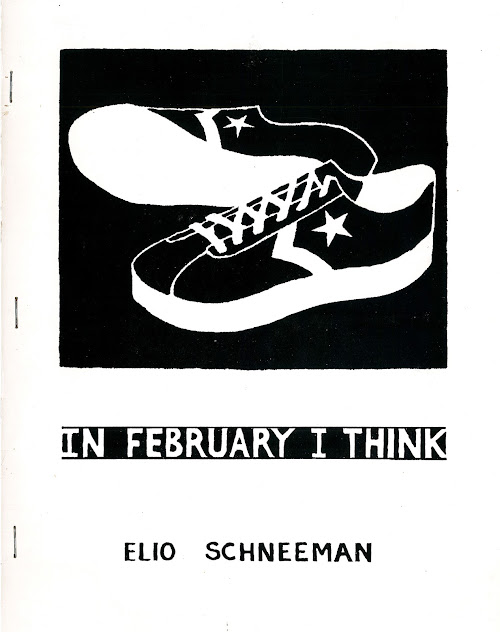
-       In February I think / Elio Schneeman. [New York City] : C Press Publications, [1978]

-       Nuclear Neighborhood / Larry Fagin. [Bolinas, Ca] : Smithereens Press, ©1983.

Once upon a time, after a reading, I handed a side-stapled (standard American) letter-sized journal to a New York Poet of a certain generation: “Ah, something familiar,” she said. This knot of such examples above, all in white papers with black and white cover art (one stamped), span a decade or so and begin to draw a diagram, taking shape like a double-jointed star or asterisk. The catalog record for Portable Leon made by the University of Michigan Library attributes the poems to Ron Padgett and Larry Fagin, per a note enclosed to Anne Waldman, while the record for More Pictures of Leon contributed by Ball State University notes that “‘Leon’ is a pseudonym of the poet Ted Berrigan.” [Cuneiform’s website hosts a marvelous scan of Big Sky 7, “The World of Leon” issue]; Adventures in Poetry was edited by Larry Fagin, C Press by Ted Berrigan. Images by Joe Brainard, Ken Botto, and George Schneeman for the collection of his son’s poems, constellate the covers and proffer a further school of thought. (That poet was Alice Notley!)


081

Dark horses and little turtles : [poems] / Richard Felger.
Guadalupita, N.M. : Nail Press, 1974.
Tooth of Time Review ; no. 1
 

Some instances—in this case, one of “200 copies printed”—become a locus for the study of: small presses + the American Southwest; a trajectory for Ethnopoetics + the transition toward ecopoetics; the dormancy of little magazines + digital circulation. This book of poems, by biologist Richard Stephen Felger, was the first issue of Tooth of Time Review, published as a monograph, reportedly printed by John Brandi on a “1903 Rotary Neostyle mimeograph, now in the archives of UC Berkeley’s Bancroft Library,” per the From a Secret Location website. Words intersperse with hand-drawn glyphs, as well as two leaves of flowchart-like “myths.” The volume is now reissued as Dark Horses and Little Turtles and Other Poems from the Anthropocene, a printable digital book from Polytropos Press.


082

Prague poems / Valerie Kuehne.
Brooklyn, N.Y. : Green Zone Editions, ©2007.

This isn’t the Valerie Kuehne who’s written on intergenerational programs; this is the musician who is also a poet. Cataloging requires a differentiation of name (by some distinguishing feature) to trace separate identities… And what if that differentiation could be tone of voice itself?—as with a quote from the poem “theory”—

Kuehne, Valerie. (“oh sorry / trying to avoid disjunction. / when she speaks it collapses, /the ideogram, / embodiment […]”)


083

Poetry city, U.S.A. : poem wrapped around the block by Dr. Alphabet ... / by Dave Morice. [Iowa City, IA] ] : Happy Press, c1977.

Title             from first page…

Cover title:   Dr. Alphabet's poetry city marathon and other sidewalk shows!

Portion title: Poem wrapped around the block by Dr. Alphabet

This is a record for that happening in Autumn, 1975, when a “poetry marathon written on paper [was] taped to the buildings bounded by Clinton St., Washington St., Dubuque St., and Iowa Ave., an entire block in downtown Iowa City.” The booklet—paged A-P—winningly “dedicated to the first 100 people who read it,” describes the communal performance, lists participants, and reproduces newspaper notices of the event, acting as both program and review.


084

The Pierrot poets / Frank Medlar, Jacqui Acon [and] Tom Weigel.
Buffalo, N.Y. : Pierrot Press, 1973.

I’ve no idea who the Pierrot Poets are, but don’t you want to know now?! (Me too.) From a great write-up by Joel Lewis on the Poetry Project’s website, I learn that Tom Weigel spent some portion of the early ’seventies in Buffalo, where apparently he began collating pages of poetry by friends he’d met along the way. The full blossoming of this would be his Andrea Doria Books imprint, including the Full Deck Anthology he edited in 1982. How great to see this earlier manifestation, illustrating the imperative to bring together, to connect, to share.


085

Die literarische Avantgarde der U.S.A. seit 1945 : mit porträts amerikanischer autoren / von Dirk Görtler.

Freiburg [im Breisgau] : Deutsch-Amerikanisches Institut ; Waldkirch : Georg-Scholz-Haus Städtische Galerie, 1988.

This catalog from an exhibition (held October 20 to November 6, 1988) features portraits of American authors by illustrator and Chelsea Hotel co-editor Dirk Görtler. Writers depicted include Kathy Acker, Paul Bowles, Richard Brautigan, William S. Burroughs, Robert Creeley, William Gaddis, Brion Gysin, Jack Kerouac, Jayne Anne Phillips, and Robert Stone, paired with selected bibliographies as an introduction to German and Swiss readers. The catalog also includes excerpts from Raymond Federman (in German). When I check our catalog for “Dirk Görtler,” I find that three other items we hold are all call-numbered as Federman pieces, and so decide to also locate this under Federman’s unique call number, predicting that the researcher may well be drawn by the scent of association among.


086

Snip! / Roger E. Erickson.
Brooklyn, N.Y. : Folding Cigar Press, [1974]

Not an actual issue of Folding Cigar, this prototype for the periodical is made from material “selected from my storage files for collage elements,” the artist notes, with his own drawings added in “to vary its visual rhythms.” My first take was that this is an issue of Folding Cigar artists’-books serial; Brown University has contributed a beautiful record to OCLC, based on the issue they hold (the “Fourth”). Often the first issue of a serial-endeavor presents as a one-off: the impetus for the project preceding seriality. But catalogers’ judgment has me hesitate… other libraries’ catalogs and booksellers’ lists reveal the first issue of that serial was numbered the “First,” copyrighted 1978. This is a good example of how the collectivity of a journal can grow from the germinal idea of the individual—the “visual text” draws page-by-page from advertisements, instructions, statistical diagrams, graphic ornaments, handwriting scraps, lists, and stencils—all evened-out in a black-and-white palette, with endpapers lusciously printed in ROYGBIV.


087

Trees / Lea Goldberg ; English translation by Sharon Kessler ; artwork by Noga Farchi.
Pardes Hanna, Israel : Fish-Eye Press, [2008], copyright 2008

How to count illustrative content? Plates are accounted for by their own [un]numbering, recorded together with pagination—as in [3 of this] , [3 of that]. In this case, there are three unnumbered pages of plates, three unnumbered leaves of poems translated from the Hebrew. The plates are tipped in, facing the text; I add a clarifying note in the body of the record… Let the quandary (3 + 3 ≠ 6) not distract from but return emphasis to Goldberg’s poems.

          The needles toll: once upon a time—
         
I’ll call the snowy distances my home,
         
the pale green ice that traps the stream,

         
the sound of poetry in a country not my own

          Perhaps only the migratory birds understand—
          suspended between earth and sky,
         
this pain of having two homelands.

          With you, I was planted twice,
         
and I have frown together with you, pines,
         
but my roots in two different landscapes lie.
 

which surely appealed to translator Sharon Kessler, who grew up in New York State, but who now—by self-description—is “[o]perating alone in the Middle East.” The lovely botanical plates are by the translator’s daughter, artist Noga Farchi.


088

An anthology. No. 2 / [edited by L.G.C. and E.H.C.?]
[Place of publication not identified] : [publisher not identified], [between 1935 and 1955?]

The cataloger must make judgements! What is this piece?—searches in OCLC by title, subject, and with various clusters of contributors’ names reveal nothing. The cataloger must assign parameters… One cannot guess where this was published, or by whom. A cluster of poems near the end of this 49-page anthology by the initialed “L.G.C.” and “E.H.C.” leads me to believe they are the editors. As for a range of years, simply stating “19uu” for any year in the 20th Century will drop the item in any date-cascading search to the year 1900… I go for a questionable range, based on the paper quality, the toning, and the lives of the contributors, as many of them seem to be contemporaries: Edwin Markham was editing anthologies in the ’30s; Ethel Romig Fuller lived from 1883 to 1965, Sara Henderson Hay from 1906 to 1987. Even with this bracketed span, I go to further lengths—listing all contributors, in hopes that a future researcher or colleague at-large with the same piece in-hand will discover this bibliographic record and improve upon the information I’ve gleaned.


089

A twist of sun : some poems / by Gardner McFall.
[Florida?] : [Gardner McFall?], [between 1972 and 1977?]

Some chapbooks seem so plainly happy! Sheets glued together into pages; covers hole-punched; bound with two loose leaf rings (2 cm in diameter), with lower ring now lost. The young poet records her travels and impressions, as well as that most companionably difficult thing to describe—friendship:

By sitting opposite
                
on the train
           We are denied

                
identical views of things
           But still that hope

                
of sharing
           A common alpine range


090

A book of short and wholly random essays accompanied by drawings the two of which to the untrained eye seemingly having nothing absolutely to do one with the other in our time: a collection / Wayne Hogan.
Cookeville, TN : little books press, [2008]

If a Zen monk offers you a large block of wood to sand down to nothing, don’t take it. This is the very sort of thing that rarely turns out the way it’s s’posed to.

I love those oppositely apostrophized esses abutting! This passage is emblematic of these humorous short prose paragraphs, arranged as chapters: “essays” that turn out not the way one might think. Allusive, oblique; the drawings (by the author) offer New York School-styled critique of advertising, some with a more heavily positive-negative conceit (closer to that of Djuna Barnes’s), where idealism and repugnance share a razor-sharp line.


091

The 52nd annual Wallace Stevens Poetry Program presents: Susan Stewart, April 1 & 2, 2015.
[Storrs, Connecticut]: The University of Connecticut English Department in the College of Liberal Arts and Sciences; [Hartford, Connecticut]: Hartford Classical Magnet School, 2015.

It’s the cataloger in me who longs to use that binary fixed field positively: (0, Not a festschrift; 1, Is a Festschrift). Alas, this too is not a festschrift… but it is an annual gathering to honor the former Hartford employee Wallace Stevens, sponsoring two readings—one at the campus of each publisher—“by a poet of national or international reputation.” The program features a poem by Stevens, a poem by 2015 honoree Susan Stewart, and poems by writing award winners from university and high school poets to watch for.


092

Up front
Toronto, Ontario: Huron Path Press, 1979-

This is the only known issue of Up Front, a little magazine out of Toronto, with editing attributed to Don Garner. The record is inaccurate, recording the issue only as “Vol. 1,” though the cover states: Vol. 1, No. 1 Sept/Oct 1979. I add in the numbering, trick out the specs to match current cataloging practices; though I can’t add Garner’s name as editor, as it’s modestly absent (though happily he’s also a contributor), so I’ll add it locally to our catalog, pointing again to the richness of in-house data. Sadly, I also update the name authority file for Don Garner to include a passing date: 1945-1989.

Every issue of a little magazine is a constellation guided by the planisphere of the editor… in this case, human relationships (self; societal; hetero/homo; sexual). Three such stars here are:

Angela Jackson (of Chicago; Nommo editor)—

          Only last spring i was a flower in the discotheques
         
an anemone of travolta
         
prancing to life, in peach and orchid pearl.

         
Kadoom! A parkinglot in the alterland lazybalm air.;;

jwcurry (still publishing then as John Curry, founder of Curvd H&z press)—

           H
                    
E E
                    
A L

                    
V L
                    
E

                    
N
          walks with a limp

and Don Garner himself—

          it’s what happens to all of us
         
in the common ongoing process
         
of history to use us, now bestial and metric

         
in its measurement of the gay heretic.         

Also featuring work by Duncan Armstrong, Bob Lee, Anthony Missiou, Yves Saint-Pierre, and Andy Solomon.


093

The mail-interview with Carol Stetser (USA) / [by Ruud Janssen].
Tilburg, Netherlands: TAM-Publications, [1997]

Representative of the vast network of mail artists as well as the aesthetics of zines, this series of pamphlets (in this case, “TAM-970171”) presents individual participants in time-stamped conversations with publisher Ruud Janssen of Holland. We learn about the artist’s publishing habits (Padma Press), travel influences (Stetser’s comments travels to three South Pacific nations, where mass print was uncommon at the time, and the forms art takes there), and working processes (collage). Given the nature of mail art’s use of date stamps and postmarks, it’s notable that Stetser worked at a post office!


094

In Attic blue / Vanessa Boff.
Boulder, Colorado: Farfalla Press, 2001.

Cheers to Farfalla Press for these marvelous covers, “designed and pressed by artist/poet Heather Ackerberg at the Harry Smith Print Ship, Naropa University, Boulder Colorado”—I drop all this info into the record, to get at local affiliations. I take these covers to be that precise blue of Attica, with poems in the dialect of classical themes: in the summer sun, lakeside, camera obscura, eroticism of the now. The cover papers bear a straightedge splotch of dark blue-violet across the front, making the silvery print of the title come to the fore, the author’s name (against Attic blue) fading back. A clip from “August Slide” goes—

          His listless fingers
         
Satie in 1920’s quiet

          I am fine

          She is belly lifting
         
Snowflake against navel

          observe his face leaning against window
         
his mouth open to say goodbye


095

Rimbaud / by Ezra Pound.
Milano: All’insegna del pesce d’oro, 1957.

These translations, first published in the Little Review, then reprinted as a chapbook nearly 40 years after, include a Rimbaudesque preface stating that “no adequate translations have yet appeared.” With drawings to illustrate from Picasso, Matisse, Modigliani—it’s the pairing of portraits on wrapper front that draw me most: Rimbaud by Marcoussis, Pound by Gaudier Brzeska. It makes me think of Dennis Cooper’s Rimbaud issue of Little Caesar (number 5, April 1978); how Rimbaud manifests every decade or so in the literary world. By Cooper’s assessment: Delmore Schwartz (’43); James Dean (’55); Syd Barrett (’67); Chris Burden (’73); Johnny Rotten (’77). To append that earlier listing: Ezra Pound, circa 1918. [Patti Smith (’75)?]


096

Frieze / Judith Grossman.
Providence, R.I.: Burning Deck, [1973]

To return to the topic of name authority control: maybe it’s the nature of time to collapse identities… in studios, guilds, and by region. But we hold back that slippage that comes by homonymy of name. See, for example: two authors named “Judith Grossman,” both writing fiction. I have before me this chapbook, assigned to Grossman, Judith, 1937- : short story writer (and wife of poet Allen Grossman). But these prose sections are highly abstracted, where narrative’s a cat’s cradle. I find a digitized John Hopkins degree conferral document [1971], naming Judith Ellen Grossman; and, in the Johns Hopkins library, a thesis of the same name under Grossman, Judith Ellen, 1946- . Without such remedy, the identity of Judith Grossman (1946-2011) who wrote these lines would remain obscured—

                    Those inside the room regard the girls as carefully
         
tended fixtures. Until the day arrives, they will always block
         
the window, shifting color only, producing like intervals of

         
even modulated tones.

[Note also the “modulated tones” of the cover by Keith Waldrop—with exquisite bar of typographic marks: f, fi, fl.]


097 & 098

Thunder-root : traditional and contemporary Native American verse / by J. Ivaloo Volborth ; [artwork: Daniel Owen Stolpe].
Los Angeles, California : American Indian Studies Center, University of California, Los Angeles, 1978.

[&]

My horse and a jukebox / by Barney Bush ; . [artwork: Richard Summers].
Los Angeles, California : American Indian Studies Center, University of California, Los Angeles, 1979.
 

UCLA was publishing this series, starting in the late ’70s. I have here on my desk two such pamphlets. From Judith Volborth’s, the poem “First Song” defies critic—invokes sentience I would only have a word like hermeticism for:

Atop the Mesa, beneath the drone of Sun
          the air that burst forth from my bird lungs
              
a silent song

          that only the heart’s eye could see;
          that only the ears of blue sand could hear. (45)

—or, this haiku, which takes title from first line: “Iron-Door-Woman, / behind downy plumed clouds. / Crows await your eyes”; further alchemy of idiom and form (49).

Barney Bush’s poems take a different approach, a-mix with consumerist- and place-name references of origin and import in lyric plain speech:

Squatted on the floor
          behind a can of Coors
              
Grey streets, Gothic

              
structures, Great Lake
              
Milwaukee

              
came into my quietness (19)


099

Padre y hijo = Father and son : Chicano thoughts / Leo and Marty Hernandez.
[N.M.] : San Marcos Press, 1974.

“Most of my poems are about the negative aspects of the farm worker’s life, because so much of it is negative and must be changed,” writes Leo Hernandez in the declaration that opens this chapbook of poems by these parent-and-child authors. “Yet that life has some positive aspects: a strong sense of togetherness and maintenance of Hispanic language and culture lost by other groups” (5). From experience, the father writes

a chicano child drops out
         
in kindergarten,
but waits until of legal age.

meanwhile lost in that foreign maze
listening to the so-called sage.

this is not a generality (13)

addressing disparities that fracture democratic notions of citizenship (crossing non-citizenship), from education access to equity before the law. Of his 15-year-old son’s poems, Leo writes: “Marty was born and raised in the middle class. As a boy, he never had to struggle like the farm workers, and he always had what he wanted. So it is not clear why he writes the kind of poetry he does,” perhaps speaking to types of inheritances—and gifts—so often otherwise invisible (6).


100

The wind in the pines : a Celtic miscellany / [compiled by George F. Maine].
Edinburgh ; London ; Boston : T.N. Foulis, Ltd., ©1922

The line between forward and backward glancing is so often a Janus-ing gaze; so it is with Modernism and Decadence, the latter embodied as The Celtic Twilight movement—Janus-ly also called the Celtic Revival. Twilight-Revival is that gaze, reinscribing ancient Celtic symbols with a modern (if not modernist) pen. This may be best viewed in the art nouveau illustrations that vivify this seam.


101

Celebrations : a new anthology of Black American poetry / compiled and edited by Arnold Adoff ; introduced by Quincy Troupe.
Chicago : Follett Pub. Co., ©1977.

Quincy Troupe’s introduction opens “A new anthology of African-American poetry is always a welcome addition to the whole of American literature” “in these most difficult of times” opens compiler Arnold Adoff’s preface—both posits valid. The vision of the compiler (and longtime spouse of the celebrated children’s author Virginia Hamilton) is contemporary, topical, and far-reaching. Beginning with Lucille Clifton’s “Africa,” the anthology divides (without chapters) into cross-themed clusters: The Idea of Ancestry; Lineage; The Southern Road; Where Is the Black Community?; Young Soul; True Love; Myself When I Am Real; Make Music with Your Life; For Malcom Who Walks in the Eyes of Our Children; A Poem for Heroes; Shade; and, For Each of You. Equally uncategorical, the choice of poets, like Clifton and (randomly selected as I thumb through) Russell Atkins, Mari Evans, Calvin Hernton, Bob Kaufman, Nate Mackey, Carolyn Rodgers, Ishmael Reed, Dudley Randall, Audre Lorde—from modernist favorites to those contemporary writers now historicized in anthology.


Edric Mesmer edits Among the Neighbors, a pamphlet series on little magazines published by the University at Buffalo’s Poetry Collection, where he works as a cataloging librarian—To subscribe to the series, just send him an email! His book, POEMS: now & then, is out from BlazeVOX [books].

most popular posts