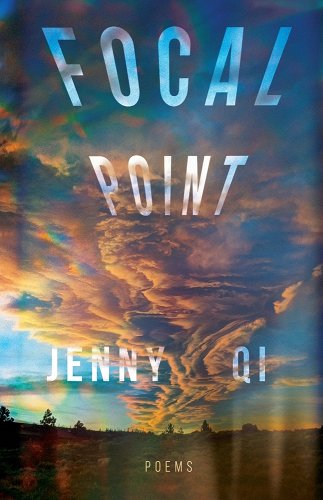
The 'process notes' pieces were originally solicited by Maw Shein Win as addendum to her teaching particular poems and poetry collections for various workshops and classes. These poems and process note by Jenny Qi is part of her curriculum for her Poetry Workshop at University of San Francisco in their MFA Program for Spring semester of 2023. https://www.usfca.edu/arts-sciences/programs/graduate/writing-mfa

In describing the process for my first poetry collection Focal Point, I’ve often said that I never set out to write a book at all. The earliest poems in this book were written sometime in college, when my mother was still alive. In 2011, exactly a month before I turned 20, she died from cancer, and a few months later, I graduated and started a PhD in cancer biology in a new city.
My mother and I had been very close, and she had been ill for nearly five years, during which I had graduated from high school and gotten most of the way through college and made all my decisions in the shadow of her worsening illness. For those and a number of other reasons, I felt so devastatingly, singularly alone in the world when she died. The only place I could find other people with experiences that felt even a little like mine was in poetry and literature, and so I kept reading and writing to survive. In retrospect, I might describe Focal Point as a tiny series of snapshots of my attempts to navigate the confusion of young adulthood in parallel with my most shattering loss.
Maybe a year into grad school, I started attending a weekly workshop run by physician-poet David Watts out of his office, and I tried to write my way out of the rubble of myself. After four years and probably a couple hundred poems, David asked me where my book was and helped me begin to organize my “best” poems into a collection. I put “best” in quotation marks because I still don’t know what that means. There are weird little poems that I didn’t like at the time and did not include, though David did convince me to add a few of those in. There are poems, such as the ones from college, that I added to the manuscript towards the end of the process because that made sense to me for the loose narrative arc of the book. So in this way, the book as a whole is also a snapshot of who I was in 2019 or 2020, when I submitted the final version, and what I thought a poem and a book of poems should be. If I were to assemble this book now, I would probably make different choices. In fact, I like to think I would, because that means I’ve grown.
When I started assembling my poems into a manuscript, I didn’t know what I was doing at all. I had to learn how to read a poetry book as a writer, consciously thinking about how the individual poems come together and how the whole becomes more than the sum of its parts. When I showed my first attempt to David, I’d put all the heavy grief poems together sort of chronologically without allowing a reader to breathe in between. In a way, that felt true to the initial relentlessness of grief but didn’t make space for its recurrence and didn’t make a good book. The gist of his feedback was that I should consider balancing the poems in terms of theme and emotional tone and think about how certain elements show up in multiple poems. When I approached the book using that framework, I found that there were images I returned to, sometimes in unexpected places.
I titled the first version I will be somewhere else yesterday, and that iteration was a finalist for the Jake Adam York Prize in 2017. I probably could have kept submitting that version, but between when I submitted the manuscript and when I received that call, the world had changed, and I changed. (At some point I even removed the poem that contains that line, so maybe it’ll be the title of a different collection someday.) In the years between that and the actual publication of Focal Point, I got more feedback from other people, read a lot of other poetry collections for inspo, took months-long breaks away from the manuscript, and sent out a few different iterations before I got to the final version. After I graduated and had some time away from the lab, I was also able to gain a different perspective on the ways in which I grew into and away from that life and how that was inextricably linked with loss. It was only then that I revisited the older “Biology Lesson” series of poems and some of the short “how-to” poems and thought about how those served as a manual for navigating loss and growth in tandem.
With each iteration of the manuscript, I had to distance myself a bit more and reimagine what my grief looked like and what this book could be beyond a retelling of my grief. When I started writing the poems that would become Focal Point, I was trying to write my way out of and away from grief. I didn’t realize until much later that I could grow to hold space for communal griefs—grief for victims of violence and injustice and disease, for people and cultures I will never know, for the intangible losses of a year in isolation, for precedented times. I began to understand that every grief is a love for something that has been or is in the process of being lost.
Point At Which Parallel Waves Converge & From Which Diverge
Researcher, prevention won’t save my life, tweets a patient
with metastatic cancer. I’m reminded of
my mother:
Why don’t you want to study cancer? when I expressed
interest in HIV. In the hospital, call
from a professor,
my mother clapping once then silence;
the roommate thirty years her senior
who called my voice lovely,
who called my mother lucky,
whom I resented because
she outlived my mother;
nights at a microscope in a dark room
where the lights turn off after ten,
sitting too still, turning a knob just so
to focus
on the right field of cells; the eight
hundred mice
I’ve sacrificed this year, injecting
cancer, harsh medicine
into their soft warm bodies, hating them
for biting me
but understanding, stroking their white
fur in apology;
covering cages with paper so they can’t
watch their sisters die.
But I can, and I see my mother in those
graying eyes,
eyes I refused to donate because how
would she see,
and I think how cruelly futile all this
erratically focused empathy, how brutal
to learn why I couldn’t save
what I couldn’t save.


Maw Shein Win's recent poetry book is Storage Unit for the Spirit House (Omnidawn), which was nominated for the Northern California Book Award in Poetry, longlisted for the PEN America Open Book Award, and shortlisted for the California Independent Booksellers Alliance's Golden Poppy Award for Poetry. D.A. Powell wrote of it, "Poetry has long been a vessel, a container of history, emotion, perceptions, keepsakes. This piercing, gorgeous collection stands both inside and outside of containment: the porcelain vase of stargazer lilies is considered alongside the galley convicts, the children sleeping on the cement floors of detention cells, the nats inside their spirit houses; the spirit houses inside their storage units.…These poems are portals to other worlds and to our own, a space in which one sees and one is seen. A marvelous, timely, and resilient book." Win's previous collections include Invisible Gifts (Manic D Press); her chapbooks include Ruins of a glittering palace (SPA) and Score and Bone (Nomadic Press). Win’s Process Note Series on periodicities : a journal of poetry and poetics features poets and their process. She is the inaugural poet laureate of El Cerrito and often collaborates with visual artists, musicians, and other writers. mawsheinwin.com