Showing posts with label Jaime Forsythe. Show all posts

Thursday, July 2, 2026

Melanie Marttila : Yield, by Jaime Forsythe

Yield, Jaime Forsythe
Wolsak and Wynn, 2026


This long poem dives into the experience of postpartum depression to which one has no choice but to yield. Early on, leaving the city with family including newborn for the seashore, “I unfold to the inarticulable / shroud”. Actions are automatic. Emotions are remote until “verging on shore, / where grey swells glide to their limits and melt.” This is the desired state, to melt into … nothing at all, or merely something else?

Presented against the backdrop of the Maritime coast, the metaphors are oceanic, reaching back to the amniotic fluid in which we all first learn to swim, and forward to a time when the postpartum veil is lifted. There are also the hallmarks of landlocked Maritime life: a dead mouse in the wall, identified by the smell of decay, the digging of wells, fields of birds and animals and insects, mudflats and bluffs. Then there are bathtubs and swimming pools and saltwater tanks, attempts to escape the weight of ideation.

At first, she flinches “passing the magnetic knife holder when I go down / / for water, like I’d close my fingers around its blade / by mistake.” She likens her breastfeeding child to lichen and the ebbing tide, remembers the pressure of birthing among other scattered memories, interspersed with facts about Maritime flora and fauna, wants to “join the sponge, the mermaid’s / purse, the moon snail … sea lettuce and invertebrates who / continue to exist” even as she relates to the bluffs, eroding “ten centimetres or fifteen each year / / and what an elegant blueprint for leaving, crumbling / exit, every hair that scores the tile a thread closer / / to stop”.

The physical trials: first menstruation post-birthing, the realization that one’s pelvic floor has weakened, stitches absorbed and an opening altered, waiting to flower, but “[c]offee grounds and death, / / peppermint oil and death: impossible to hide / the chemical reaction, decomposition wallpapered / / to our nostrils, our skulls.” Ideation slinks “in the dysphoric slide post-letdown … Letdown and every burner / left on high, door bolted from the inside.”

Also:

I’ve walked alone just as the sun’s gone
neon, in clouds of mosquitoes, ears ringing

from your scream, the meadow rife with hidden
wells ready to take me. Dark mouths under long

grass, inexplicable – easy. A matter of one step
into a slot – a room – a womb.

Later, Forsythe’s verse fragments—things always get worse before they get better—becomes lists of things seen, without explanation or sense. Sleep deprivation drains and dysregulates, enforces a kind of narcolepsy, sleep taking its chances wherever it finds them. Life blurs, becomes a dream, a mosaic of memory.

Observation becomes a means of healing, of reclamation: “I take notes in case / I’m asked to prove what I’ve seen with two eyes, / / sketch the reeds snaking in through the window’s / gap.”

Until finally:

“… I didn’t

expect to still be here, hunched over the unresolvable, bobbing
between fight and surrender. The signal fades in and out and out

and I want to join the air, which I’m told is a door to the next
phase of thinking where I learn to unlatch from my spirals.”

Liminality and the juxtaposition of states play out in couplets. A gorgeous exploration of the postpartum experience.


Melanie Marttila (she/her) is an #ActuallyAutistic author-in-progress, writing poetry and tales of hope in the face of adversity. Her poetry has appeared in The /tƐmz/ Review, Polar Starlight, Sulphur, and her debut poetry collection, The Art of Floating, was published in 2024 by Latitude 46. Her short fiction has appeared in SuperCanucks, Through the Portal, and Pulp Literature. She is a settler writing in Sudbury, or ‘N’Swakamok, on Robinson-Huron Treaty territory, home of the Atikameksheng Anishnawbek and the Wahnapitae First Nation, in the house where three generations of her family have lived, on the street that bears her surname, with her spouse and their dog, Torvi.

Thursday, June 4, 2026

rob mclennan : Yield, by Jaime Forsythe

Yield, Jaime Forsythe
Wolsak & Wynn, 2026


The third full-length poetry title by East Coast poet Jaime Forsythe, following Sympathy Loophole (Toronto ON: Mansfield Press, 2012) and I Heard Something (Vancouver BC: Anvil Press/a feed dog book, 2018), is Yield (Hamilton ON: Wolsak & Wynn, 2026), a collection constructed as a book-length accumulation of untitled, clustered poem-structures. Yield is less a collection of poems, say, than a single idea that reveals itself, slowly, one piece at a time, offering its title both as the result of what had been planted, and the suggestion of, if not to give in, but to be open, allow. “In these dreamlike lines a mother faces the postpartum voice from a porous house by the ocean as the veil between land and sea,” the back cover copy writes, “and between being lost and being found, grows thinner.” There is an abstract across Forsythe’s lyric, one through which better to articulate the space within, one might say. “Moon snail bores a hole / in the shell of its prey,” she writes, “husks to be strung / into jewellery once // sucked dry. Intertidal / empties littler the sand, // sharp on bare feet.”

Subtitled “a poem,” Yield floats as a singular, extended structure through a blend of ecopoetic and pregnancy/motherhood, articulating a sequence of meditative lyric fragments around fragility, ecologies and post-partum isolations. “Field interrupted by crop circles,” she writes, mid-way through the collection, “wheat / depressed where I flatten to watch the drone // do its scenic capture, propellered eye / rolling over bivalves, tire swings, bald eagle // who waits out UFOs from a pine. I was saying / something when I came out here to lie down // in the path split through a paragraph of reeds, / egg-shaped structure in the distance, dropped // pendant a period.”

Her lyric is detailed, intimate and immersive; composed via an adherence to the accumulated couplets and line breaks, a structure clearly and carefully constructed, even across the more overt collision of words, words. “I paid to float in a tank of salt water / boasting ten times the salinity of sea. // At eight months along, I gladly gave up / gravity, invited exceptions to the accepted // theories. The bleached pod was dark and hushed / but for my own internal sloshing, and yours, // sealed away from diesel engine, perennial / siren, voice of crow. With credit, I could afford // submersion three times over forty-one weeks. / To abandon the world’s din for zero symphonic // decibels a luxury tinted with shame.” There’s a clatter to Forsythe’s lyric movement, seeking calm through the chaos, with a structure carved, perhaps, as a kind of scaffolding, all that might hold the subject matter together. With a clear eye, Forsythe’s lyric is at turns grounded while being ungrounded while impossibly ground down, attempting a clarity, perhaps, through the composition itself. “When blood volume balloons and abdomen / hardens,” she writes, near the end, “that’s a warning about endurance.”

Barrier of black spruce
orange sky threaded with branches 

over the crib’s parenthesis
where you don’t sleep 

on parading llamas
I wade into the temperate quarry 

bathing suit bunched, stroke
the grey mirror 

foil surface of joy
your wet wiggle 

buttoned into polka-dotted
pyjamas a pearl 

appears
on blushing gums


rob mclennan has a new poetry book out this month, edgeless, with Caitlin Press, and a chapbook out right now with Broke Press. Another chapbook is due soon with Subpress, his first of a supposed three, which is pretty cool, also.

Friday, February 4, 2022

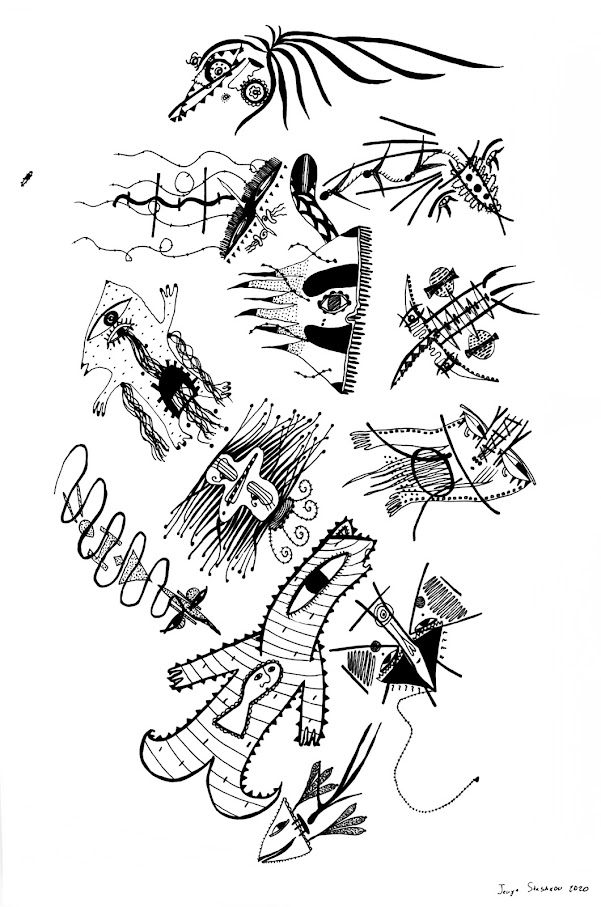
Jenya Stashkov : 15 Canadian Poems (black gel pen, paper, 2019)


TERRARIUM by DÉLANI VALIN


MY MOTHER AND I SAT WAITING FOR DEATH by MICHAEL DENNIS


THE GREAT OUTDOORS by ALICE BURDICK


CLOUDS by NELSON BALL


SENTENCE by STEVE VENRIGHT


SONG by GARY BARWIN


THIRTY-ONE AWAKENINGS by JASON CAMLOT


FLOWERS by LANCE LA ROCQUE


DIRECTION by AYESHA CHATTERJEE


ONCE OR MANY TIMES MORE by JAIME FORSYTHE


BEWARE THE FAILURE OF IMAGINATION by ROB MCLENNAN


CONNIPTION SAUCE by STUART ROSS


THIS MUCH by ROBERT HOGG


TRUE by TERESE PIERRE


TRANSPLANT by MARGO LAPIERRE


Evgenii 'Jenya' Stashkov (Russia) is an illustrator, artist, playwright, poet, and performer. His artistic and literary works have been exhibited and published in Canada, USA, UK, Japan, Austria, India, Germany and Pakistan. He is the founder of the performance troupe VIBRATING BODY, the organizer of the «Neem» Independent International Award for Improper Dramaturgy.


most popular posts